Data loss is a real problem. Companies lose sensitive files every day, whether through careless employees, malicious insiders, or simple mistakes. If you rely on Code42 for insider risk management and data protection, you may have started asking whether there are better options out there, especially as using AI to categorize data becomes a standard expectation in modern security tools. This article walks you through 7 strong Code42 alternatives that can help you protect sensitive data without the gaps or limitations you might be running into right now.
Finding the right data loss prevention tool takes time, and comparing features across platforms can feel overwhelming. That is where Numerous, a spreadsheet AI tool, makes a real difference. It helps you organize, compare, and evaluate your options directly in a familiar spreadsheet environment, so you can make a clear, informed decision about which Code42 alternative best fits your data security needs.
Table of Contents
Why Insider Risk Teams Look for Code42 Alternatives
The Hidden Cost of Choosing the Wrong Insider Risk Platform
7 Best Code42 Alternatives to Protect Sensitive Data
The 20-Minute Workflow to Evaluate Code42 Alternatives
Compare Code42 Alternatives Faster With Numerous
Summary
Insider risk programs rarely fail because of a single dramatic incident. The more common pattern is gradual misalignment, where an organization grows, its threat surface expands, and a platform calibrated for an earlier environment creates quiet blind spots that go unnoticed until they become costly. The complexity of modern data movement compounds this problem, with Code42 alone detecting insider risk across 100 or more data exposure vectors.
Alert fatigue is one of the most underreported operational risks in insider risk management. According to the 2025 Insider Risk Report from Intelligent CISO, 60% of security leaders say their current insider risk tools generate too many false positives. When alert noise reaches that level, real threats do not just get delayed; they get buried under irrelevant signals that drain investigator attention and erode confidence in the platform.
The financial stakes of platform misalignment are significant and often invisible until after a contract is signed. DeepStrike's Insider Threat Statistics 2025 report that insider threats cost organizations an average of $17.4 million annually. A platform that slows investigation or limits visibility into file movement extends the window during which a threat remains uncontained, and that extended window directly increases financial exposure.
Human error drives most real-world data loss incidents, yet many platforms are built primarily to detect malicious actors. Research cited in Strac Blog's 2024 analysis indicates that 85% of data leaks involve human error rather than deliberate theft, and that 60% of data breaches involve insiders.
Structured evaluation frameworks change the quality of platform decisions more than the speed. Teams that define sensitive data categories, compliance requirements, and operational constraints before reviewing any vendor produce shortlists that reflect their actual environment rather than a demo impression.
Numerous' spreadsheet AI tools address the fragmentation that slows insider risk platform evaluations by letting teams run AI-assisted comparisons directly inside Google Sheets or Excel, keeping vendor data, compliance criteria, and scoring in one organized place without requiring a separate workflow or technical setup.
Why Insider Risk Teams Look for Code42 Alternatives
Insider risk teams rarely wake up one morning and decide their platform is broken. What actually happens is quieter and more gradual: the organization grows, the threat surface expands, and the platform that once felt like a perfect fit starts creating friction in places it never did before. The problem is almost never Code42 itself. The problem is that security requirements evolve faster than most teams anticipate, and a tool calibrated for yesterday's environment struggles to keep pace with today's operational complexity.
When Growth Changes What Enough Means
When an organization adds contractors, expands cloud application usage, and pushes sensitive data across more endpoints, the insider risk picture changes shape entirely. A platform that monitored 200 employees across a single environment behaves very differently when asked to cover 2,000 users across hybrid infrastructure, personal devices, and a dozen SaaS applications.
The visibility gaps that emerge are not dramatic failures. They are quiet blind spots, and quiet blind spots are the most dangerous kind. According to the Cybersecurity Excellence Awards, Code42 detects insider risk across 100+ data exposure vectors, which reflects how genuinely complex modern data movement has become. That complexity does not shrink as organizations scale. It compounds.
The Context-switching Trap That Slows Every Team Down
The failure point is usually not the detection. It is what happens after detection. Insider risk teams spend significant time moving between reviewing user activity, investigating alerts, managing policy updates, and preparing compliance documentation.
Each transition costs cognitive energy and clock time.
Over weeks and months, that overhead accumulates into a serious operational drag that no amount of additional headcount fully resolves.
Most teams handle this fragmentation by building manual workarounds:
Spreadsheets tracking investigation status
Shared documents logging policy exceptions
Email threads coordinating audit responses
The approach feels manageable at first. As the volume of incidents and compliance obligations grows, those workarounds become their own maintenance burden, layered on top of the original problem.
Streamlining Insider Threat Tool Evaluation
Teams comparing insider threat detection platforms often find that the evaluation process itself creates the same fragmentation problem. Assessing data loss prevention tools, user behavior analytics capabilities, endpoint monitoring depth, and compliance reporting features across multiple vendors is genuinely complex work. A spreadsheet AI tool like Numerous helps security teams organize that comparison directly inside Google Sheets or Excel, using AI to categorize features, flag gaps, and surface tradeoffs without requiring a separate platform or technical setup. The evaluation becomes structured rather than scattered.
Compliance Pressure Does Not Plateau
Regulatory requirements under frameworks such as GDPR, HIPAA, and PCI DSS do not remain static. Enforcement interpretations shift, audit expectations tighten, and organizations operating across multiple jurisdictions often find themselves managing overlapping compliance obligations simultaneously. An insider risk platform that provided adequate reporting two years ago may now fall short of what auditors expect to see documented.
The Nightfall AI analysis, covering Code42 Incydr's capabilities and limitations across 60+ frequently asked questions, illustrates just how much operational and compliance detail security teams need to evaluate before committing to any platform. That depth of scrutiny is not excessive. It reflects what responsible security governance actually requires when regulatory stakes are high.
The Real Driver Behind Platform Evaluations
The pattern that surfaces repeatedly across insider risk teams is this: organizations do not evaluate data exfiltration prevention alternatives because their current platform failed dramatically. They evaluate alternatives because their security environment quietly outgrew what that platform was designed to handle. The gap between current capabilities and current requirements is the actual trigger.
Recognizing that gap early, before it creates an incident or a compliance failure, is the difference between a proactive security posture and a reactive one. Evaluating insider risk management platforms with that clarity in mind changes the entire framing of the decision.
Related Reading
The Hidden Cost of Choosing the Wrong Insider Risk Platform
Choosing the wrong insider risk platform doesn't announce itself with a dramatic failure. It bleeds out slowly, through hours of alert review that lead nowhere, through investigation queues that stretch longer each week, through compliance reports that require manual assembly because the platform wasn't built for your environment. The failure point is usually operational fit, not feature gaps. Most platforms can detect suspicious behavior in a controlled demo.
What demos don't show is what happens at month three, when your team is managing 400 alerts a week, and 60% of them are noise. According to the 2025 Insider Risk Report from Intelligent CISO, 60% of security leaders say their current insider risk tools generate too many false positives, leading to alert fatigue. That's not a minor inconvenience. Alert fatigue is where real threats disappear, buried under the weight of irrelevant signals.
Why Misaligned Platforms Multiply Work, Not Results
The same issue arises in endpoint detection and data loss prevention: when the tool doesn't align with how the team actually operates, people build workarounds. They create spreadsheets to track what the platform misses. They schedule extra review meetings to compensate for weak automation. They write manual policy adjustments that should have been handled by the system. Every workaround is a signal that the platform is working against the team, not with it. And workarounds compound. What starts as a 30-minute weekly patch becomes a full process that nobody owns.
Rethinking Insider Risk Workflow Complexity
Most teams handle this by adjusting their expectations rather than their platform. They absorb the friction, normalize the overhead, and assume that insider risk management is just inherently complex. But the complexity isn't coming from the problem. It's coming from a tool that was built for a different organization's threat model, workflow, and scale. Teams that work through large volumes of categorized user behavior data, alert logs, and policy documentation often find that tools like Numerous let them run AI-assisted analysis directly inside the spreadsheets they already use, without building a separate workflow just to make sense of what the platform surfaces.
What the Numbers Reveal About Containment Costs
The cost of misalignment isn't hypothetical. DeepStrike's Insider Threat Statistics 2025 report states that insider threats cost organizations $17.4 million annually. A platform that slows investigation, generates alert noise, or limits visibility into file movement and user behavior doesn't just create administrative friction. It extends the window during which a threat goes uncontained, and every day that window stays open, the financial exposure grows. Choosing a Code42 alternative based on feature volume rather than operational fit doesn't reduce that exposure. It often widens it.
Choosing Tools Your Team Can Act On
The truth is that the best user activity monitoring solution, the most capable data exfiltration detection engine, or the most sophisticated behavior analytics platform means very little if your team can't act on what it surfaces quickly and accurately. Platform selection isn't a procurement decision. It's a security decision, and the wrong one has a cost that doesn't show up until well after the contract is signed.
Related Reading
7 Best Code42 Alternatives to Protect Sensitive Data
Choosing the right Code42 alternative comes down to matching the platform to your specific environment, not chasing the most impressive feature list. The seven platforms below each address a distinct combination of insider risk detection, data loss prevention, and compliance requirements. Understanding where each one fits saves your team from the slow drain of discovering misalignment after deployment.
1. Microsoft Purview Insider Risk Management

Microsoft Purview works best when your organization already lives inside the Microsoft 365 ecosystem. It connects insider risk signals directly to the tools your team already uses, reducing integration overhead and accelerating time to actionable alerts. The compliance reporting layer is particularly strong for organizations navigating regulatory requirements across multiple jurisdictions.
2. Varonis

The failure point for many insider risk programs is not detection. It is understanding what data was touched, by whom, and whether that access made sense. Varonis answers that question directly by mapping user behavior against data permissions, surfacing anomalies in how sensitive files are accessed rather than just flagging movement. For organizations managing large volumes of unstructured data across file shares and cloud storage, that depth of visibility is difficult to replicate elsewhere.
According to Strac Blog's 2024 analysis of Code42 Incydr alternatives, 60% of data breaches involve insiders, which means the access governance layer Varonis provides is not a secondary feature. It is often the primary line of defense. Teams that treat permission management as a compliance checkbox rather than a security control tend to discover that gap at the worst possible time.
3. Forcepoint DLP
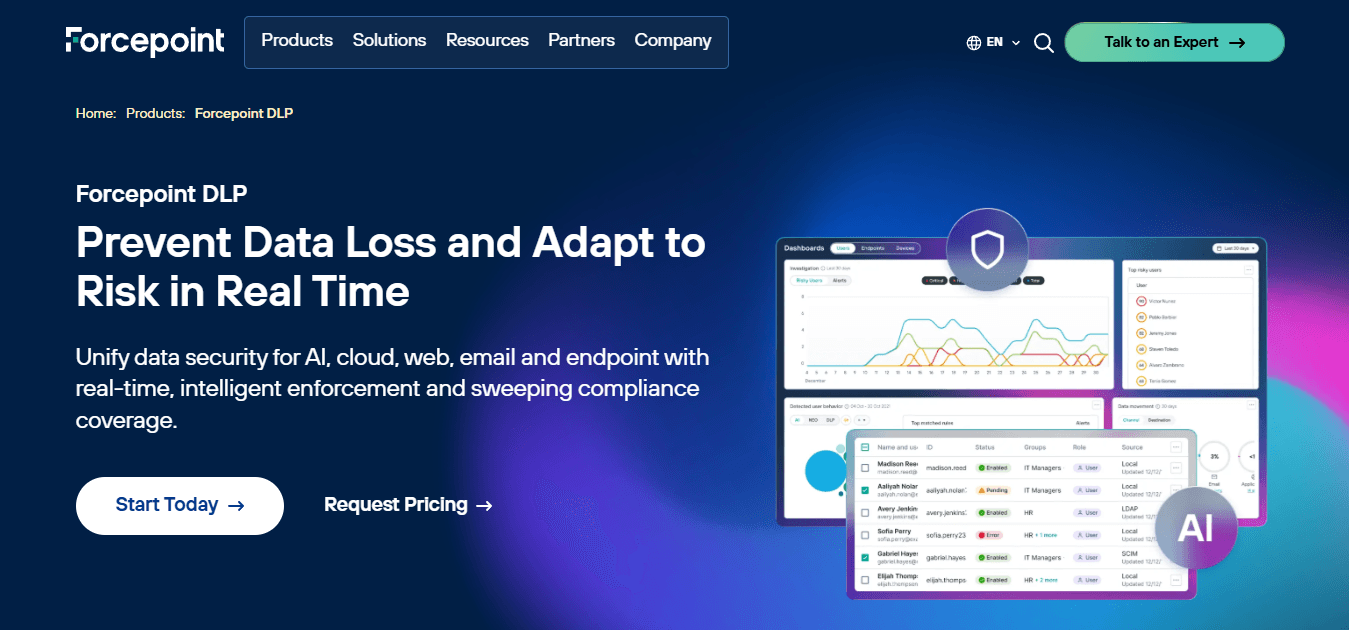
If your sensitive data moves across endpoints, cloud applications, email, and network traffic simultaneously, point solutions create blind spots. Forcepoint DLP is built for that multi-channel reality, enforcing policy consistently regardless of where data travels. Organizations in regulated industries with strict data residency or transfer requirements tend to find the policy enforcement architecture particularly well suited to their needs.
Scaling Data Classification via Spreadsheet AI
Most teams handling enterprise-wide data protection start by building policies manually, mapping each data type to a rule set in a spreadsheet before translating it into platform configuration. That process works at a small scale, but as data categories multiply and regulatory requirements shift, the spreadsheet becomes a liability rather than a system. Numerous' spreadsheet AI tools let teams use AI directly inside Google Sheets or Excel to classify, categorize, and organize data types at scale, reducing the manual overhead before configuration even begins.
4. Trellix DLP
Endpoint security is often the weakest link in data loss prevention strategies. Trellix DLP focuses specifically on controlling how sensitive information leaves endpoints and removable devices, which is especially important in environments where employees work across personal and corporate hardware. The device control and content inspection capabilities provide security teams with a clear audit trail when incidents occur.
5. Proofpoint Insider Threat Management

The critical difference between detecting a threat and preventing a loss is timing. Proofpoint's behavior analytics and risk scoring are designed to surface high-risk user patterns before data actually leaves the organization, giving security teams a window to intervene rather than investigate after the fact. For organizations where the insider threat profile skews toward negligent or compromised users rather than malicious ones, that early warning capability changes the economics of the entire program.
The same logic applies when you consider the broader data. Strac Blog's 2024 research notes that 85% of data leaks involve human error rather than deliberate theft. A platform built primarily around catching malicious actors will miss the vast majority of real-world incidents. Proofpoint's approach accounts for that reality by treating risk as a spectrum rather than a binary.
6. Teramind
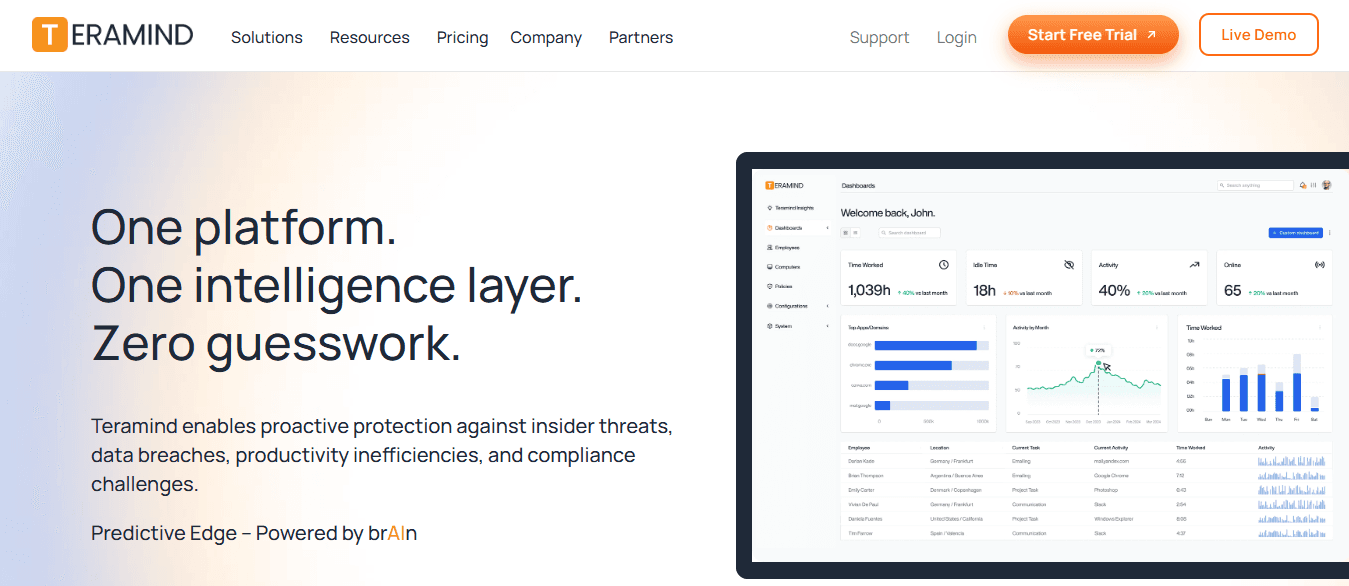
When investigations stall, it is usually because the evidence trail is incomplete. Teramind's session recording and granular user activity monitoring create a detailed record that supports both security investigations and compliance documentation. Organizations that operate in high-accountability environments, such as financial services or healthcare, often find that the level of forensic detail justifies the investment on its own.
7. Digital Guardian

Constraint-based reasoning applies here: if your organization handles regulated data categories like intellectual property, healthcare records, or defense-related information, the tolerance for data loss is effectively zero. Digital Guardian combines endpoint DLP with data classification and behavior monitoring, treating sensitive data as the primary asset to protect rather than an afterthought in network security. The cloud protection layer extends that coverage beyond the perimeter, which matters as more regulated data moves into hybrid and multi-cloud environments.
Matching the Platform to the Problem
The pattern that surfaces consistently across insider risk programs is that platform selection fails when organizations lead with vendor reputation rather than operational requirements. A platform that excels at behavioral analytics in a Microsoft-heavy environment will underperform in an organization that runs primarily on unstructured file systems. The fit between your data environment and the platform's detection logic determines whether your team spends time on real threats or on managing false positives.
Defining the Problem Before the Solution
What separates the teams that get this right is not technical sophistication. It is the discipline of defining the problem before evaluating the solution. That means mapping your sensitive data categories, identifying your highest-risk data movement paths, and understanding where your current visibility gaps actually live before a single demo is scheduled.
The 20-Minute Workflow to Evaluate Code42 Alternatives
You do not compare platforms before knowing what you are protecting. That single rule separates evaluations that take weeks from ones that take twenty minutes. The structure is straightforward:
Requirements first
Platform comparison second
Vendor shortlisting third
Each step builds on the one before it. Skip the sequence, and every platform starts to look identical, which is exactly why so many evaluations stall before they produce a decision.
Minutes 0–3: Define Your Insider Risk Requirements
Start with the data, not the demo. Before any platform enters the conversation, your team needs to agree on what sensitive data is actually at risk:
Employee records
Intellectual property
Regulated information
Privileged user activity
Without that anchor, you are comparing platforms against each other rather than against your actual security problem. Different organizations face genuinely different insider risk profiles. A financial services team worried about unauthorized data exfiltration across endpoints has almost nothing in common with a healthcare organization managing privileged user access to patient records. The requirements conversation is what makes the comparison meaningful.
Minutes 3–6: Identify Compliance and Monitoring Needs
Once you know what you are protecting, define what your environment requires to protect it. That means specifying capabilities such as:
User activity monitoring
Behavior analytics
Risk scoring
Audit reporting
DLP integration
Regulatory compliance coverage
This step does most of the filtering work before you ever open a vendor comparison page. The failure point here is treating compliance requirements as a checkbox rather than a filter. When you define them precisely, platforms that cannot support your audit reporting workflow or lack the regulatory coverage your industry requires eliminate themselves. That is not rejection; that is efficiency.
Minutes 6–10: Compare Core Insider Risk Capabilities
The strongest insider risk platform is not the one with the longest feature list. It is the one that helps your team detect, investigate, and respond to insider threats within your specific environment. That distinction matters because feature-rich platforms often create operational overhead that slows investigation rather than accelerating it.
When comparing behavior analytics, incident investigation workflows, policy enforcement, and case management capabilities, measure each capability against your requirements within the first 3 minutes. If a platform excels at endpoint detection but your highest-risk data movement happens across cloud applications, that strength is irrelevant to your evaluation.
Automating the Feature Comparison Matrix
Most teams handle the comparison phase by building a spreadsheet of features pulled from vendor websites, then scoring each platform manually across dozens of rows. As the list of alternatives grows, that spreadsheet becomes unwieldy fast, with inconsistent scoring, duplicated queries, and no reliable way to surface which platform actually fits the requirements you defined.
Teams using a spreadsheet AI tool find that running AI functions directly in their comparison sheet, using a simple =AI formula against their own requirements, significantly reduces manual scoring while keeping the evaluation within a familiar workflow rather than on a new platform.
Minutes 10–15: Evaluate Deployment and Operational Fit
A platform that is difficult to manage creates work that compounds over time. Deployment fit covers Microsoft 365 integration, endpoint coverage, cloud application support, automation capabilities, and administrative workload. These are not secondary concerns; they are what determine whether your security team can actually operate the platform at scale.
According to the Cyberhaven Blog, there are 6 best insider risk management alternatives worth serious consideration for 2026, which signals how quickly this market is evolving. That pace makes operational fit even more critical: a platform that requires heavy manual configuration today will demand even more resources as your environment grows.
Minutes 15–20: Shortlist the Best-Fit Platforms
The goal at this stage is not to pick a winner. The goal is to eliminate poor-fit solutions, so your team can focus time and attention on the platforms that genuinely align with your insider risk strategy. Shortlisting based on insider risk visibility, ease of investigation, compliance support, integration flexibility, and long-term scalability yields a focused list that enables a faster, more defensible final decision.
WatchTowr Labs notes that the full workflow to evaluate Code42 alternatives takes approximately 20 minutes when the evaluation follows a structured framework. That time reduction does not come from cutting corners. It comes from sequencing the work correctly so that each step eliminates options rather than adding them.
Before vs. After: What Structured Evaluation Actually Changes
Before a structured approach: most teams review vendor websites without a clear filter, compare features without defined requirements, and treat every platform as equally worth evaluating. The result is slow decisions based on surface-level comparisons that do not align with actual security needs.
After applying this framework: the evaluation produces well-defined insider risk requirements, a structured platform comparison aligned with those requirements, and a focused shortlist of solutions that fit the environment. The difference is not speed for its own sake. It is clarity that comes from doing the work in the right order.
The part that surprises most teams is how much the shortlist changes when requirements are defined first. Platforms that looked compelling in a demo look completely different when measured against specific data movement risks, compliance obligations, and operational constraints your team actually lives with.
Compare Code42 Alternatives Faster With Numerous
The gap between a promising demo and a platform that actually fits your environment is where most evaluations stall. The fix is not more research time. It is a repeatable system that turns scattered vendor notes into structured, side-by-side comparisons without having to rebuild the process from scratch each time.
Most teams handle this by toggling between vendor websites, analyst reports, and manual spreadsheets before a single comparison gets made. That friction compounds fast. Numerous, a spreadsheet AI tool, lets you bring vendor feature lists, compliance criteria, and evaluation notes into one spreadsheet and compare insider risk platforms using simple AI prompts directly inside Google Sheets or Excel, no API keys or specialized tools required.
Teams that start there move from scattered research to a decision-ready shortlist in minutes, not days. The insider risk teams that choose well are not evaluating more platforms. They are evaluating smarter, from a single organized foundation that makes every future assessment faster and more consistent than the last.
Related Reading
Netskope Alternatives
Symantec DLP Alternative
Varonis Alternatives
Code42 Alternatives