
Protecting sensitive data is a real challenge, especially when using AI to categorize data across large volumes of files, emails, and cloud storage. If you rely on Nightfall AI for data loss prevention and are wondering whether better options exist, you are not alone. This article walks you through 10 strong Nightfall AI alternatives that can help you detect, classify, and secure sensitive information without the headaches.
One tool worth keeping close is Numerous' spreadsheet AI tool, which makes it surprisingly straightforward to organize and review sensitive data directly inside a spreadsheet. Instead of juggling multiple data security platforms, you can use it to quickly sort, flag, and categorize information so your team always knows what needs protection and where it lives.
Table of Content
The Hidden Cost of Choosing the Wrong Data Security Platform
The 20-Minute Workflow to Evaluate Nightfall AI Alternatives
Summary
Sensitive data exposure risks grow faster than most security teams anticipate. Research cited in the article notes that 55% of organizations report employees use AI tools without IT approval, creating shadow AI risks that standard data loss prevention tools are not built to catch. As cloud footprints expand across multiple SaaS platforms simultaneously, the gap between what a security platform was designed for and what an organization actually needs widens faster than most teams expect.
Choosing the wrong data security platform carries a financial cost that goes beyond subscription fees. According to the IBM Cost of a Data Breach Report 2024, breaches involving shadow data cost organizations an average of USD 5.72 million, 16% higher than the overall average.
Automation in security platforms delivers measurable value, but only when it actually runs without constant maintenance. Organizations that deployed AI and automation in security saved an average of $2.22 million in breach costs, according to IBM data cited in the article. Platforms that require ongoing reconfiguration to reduce false positives are delivering the appearance of automation rather than the operational benefit of it.
Compliance requirements are consistently treated as an afterthought in platform evaluations, leading to costly problems late in the selection process. Frameworks such as the EU AI Act Article 12, NIST AI RMF, HIPAA, GDPR, and PCI DSS should serve as primary filters before feature comparisons begin.
Structured evaluation consistently produces better outcomes than feature-first comparisons. Teams that define data types, map their cloud application footprint, and identify compliance requirements before opening vendor documentation eliminate poor-fit options earlier and invest time only in candidates that can realistically serve their environment.
Numerous' spreadsheet AI tool addresses the data classification bottleneck that surfaces during security platform evaluations by letting teams run AI-powered categorization directly inside Google Sheets or Excel, without additional setup or tooling, so requirements documents and vendor comparison frameworks stay current rather than reflecting last month's review cycle.
Why Security Teams Look for Nightfall AI Alternatives

Security requirements don't stay still. As organizations add SaaS tools, onboard more employees, and expand into new cloud environments, the data protection platform that worked 18 months ago starts to show seams. The search for Nightfall AI alternatives is rarely about dissatisfaction with a single feature. It's about a growing gap between what a platform was built for and what the organization now needs.
Shadow AI Expands DLP Risk
That gap compounds faster than most teams expect. 55% of organizations report employees use AI tools without IT approval, creating shadow AI risks that basic DLP tools miss. When sensitive data starts moving through unauthorized channels, even a well-configured data loss prevention platform can leave blind spots. The problem isn't the original tool choice. It's that the threat surface kept expanding while the toolset stayed fixed.
Multi-Platform Security Workflows
The operational pressure compounds the visibility problem. Security teams managing cloud data protection across Google Workspace, Microsoft 365, Slack, GitHub, and Salesforce aren't dealing with one environment. They're managing five or more, each with its own:
Sharing behaviors
Permission structures
Compliance exposure
Switching between platforms to investigate a single incident wastes time that most lean security teams don't have. The bottleneck isn't detection. It's coordination.
Manual Sensitive Data Review
Most teams handle sensitive data review by pulling exports into spreadsheets and manually categorizing records across tabs. It's familiar, requires no new tools, and feels controlled. But as data volumes grow and classification categories multiply, that manual process becomes the slowest part of the workflow.
Teams using Numerous' spreadsheet AI tool find they can classify, flag, and organize sensitive records directly in Google Sheets or Excel with a simple =AI function, reducing categorization time without adding another platform to the stack.
Compliance and AI Governance
Compliance pressure accelerates the evaluation cycle. Organizations managing GDPR, HIPAA, PCI DSS, and ISO 27001 simultaneously need platforms that can enforce policies, generate audit trails, and surface reporting without manual assembly.
Research from Hack The Box's Workforce Intelligence Report found that 74% of cybersecurity professionals now rank AI security as a top priority, which signals that compliance and AI governance are converging into a single operational challenge. Platforms evaluated as Nightfall alternatives increasingly need to address both rather than treat them as separate concerns.
When Security Tools No Longer Fit
The truth is that no platform evaluation happens in a vacuum. Security teams compare cloud DLP tools, data discovery platforms, and sensitive data monitoring solutions because their current stack no longer maps cleanly to their current risk profile. That misalignment is quiet at first, then suddenly very loud.
Related Reading
The Hidden Cost of Choosing the Wrong Data Security Platform

Choosing the wrong data security platform does not announce itself. It accumulates quietly, in the form of extra hours spent adjusting policies, reviewing alerts that lead nowhere, and rebuilding integrations that should have worked out of the box. The real cost is not a single failure. It is the slow erosion of your team's capacity to focus on actual threats.
Why Operational Fit Matters More Than Feature Count
The failure point is usually invisible during vendor evaluations. Security teams compare dashboards, watch polished demos, and review feature matrices, then select the platform that looks most capable on paper. But capability on paper and capability inside your specific environment are two different things.
A cloud DLP tool that performs brilliantly in a controlled demo can introduce weeks of configuration overhead once it encounters your actual data flows, cloud application mix, and compliance requirements.
Shadow Data Drives Breach Costs
According to the IBM Cost of a Data Breach Report 2024, breaches involving shadow data cost organizations an average of USD 5.72 million, which is 16% higher than the overall breach average. That premium exists precisely because shadow data problems compound when security platforms lack the depth to surface what they cannot see. A platform with weaker data discovery accuracy does not just miss files. It misses the risk category that costs the most.
Spreadsheet-Based Classification Bottlenecks
Most teams handle sensitive data classification by building manual workflows in spreadsheets, tagging assets by hand, and updating policies as new cloud applications get added. That approach is not wrong for small environments. But as cloud footprints grow across Google Workspace, Microsoft 365, Slack, and Salesforce simultaneously, the spreadsheet becomes a bottleneck rather than a system.
Teams using a tool like spreadsheet AI tool find they can automate the classification layer directly inside the tools they already use, without standing up a new platform or learning a new interface, which removes one layer of operational friction from an already stretched workflow.
The Automation Gap That Quietly Drains Resources
The same issue arises across enterprise security teams and lean startup security functions alike: the platforms that promise the most automation often require the most configuration to achieve it. You spend the first three months building the automation instead of using it. According to Huntress, citing the IBM Cost of a Data Breach Report, organizations that deployed AI and automation in security saved an average of $2.22 million in breach costs. That number only materializes if the automation actually runs. A platform that requires constant tuning to avoid false positives is not delivering automation. It is delivering the illusion of it.
Post-Deployment Tool Fit
The critical difference between a platform that fits and one that fights you is not found in the vendor's documentation. It shows up six weeks after deployment, when your team either moves faster or spends Tuesday afternoons reconfiguring rules that should have been stable.
Sensitive data monitoring, cloud data loss prevention, and data discovery accuracy are not features you check off a list. They are capabilities that either integrate cleanly into how your team works or quietly consume the time your team should be spending elsewhere.
10 Best Nightfall AI Alternatives to Protect Sensitive Data
The best Nightfall AI alternative is not the one with the longest feature list. It is the one that fits your environment, your team's capacity, and the specific data risks you are actually managing. That distinction matters more than any benchmark comparison.
1. Microsoft Purview

When your organization runs on Microsoft 365, Microsoft Purview is not just a logical choice. It is the path of least resistance.
It classifies and protects sensitive data across:
Exchange
SharePoint
Teams
OneDrive
It’s from a single control plane, which means your security team is not stitching together separate policies across disconnected tools. For organizations with compliance obligations around GDPR, HIPAA, or SOC 2, the built-in regulatory templates reduce the setup time that typically consumes the first weeks of any DLP deployment.
The critical difference between Purview and most alternatives is the depth of native integration. Other platforms connect to Microsoft environments through APIs. Purview lives inside them, which changes how accurately it can detect sensitive information in motion rather than just at rest.
2. Varonis
The failure point in most data security programs is not detection. It is knowing where sensitive data actually lives and who has access to it before something goes wrong. Varonis addresses that specific problem with a level of precision that most DLP platforms skip entirely. It:
Maps permissions
Tracks data movement
Flags behavioral anomalies across file systems and cloud storage
This gives security teams a clear picture of exposure before a breach forces the conversation. Varonis is especially effective for organizations managing large volumes of unstructured data, where most sensitive information is hidden and where most DLP tools generate the most noise. Its automated remediation features reduce the manual triage burden that security analysts face when alert volumes spike.
3. Netskope
Cloud-first environments create a specific problem:
Sensitive data moves across dozens of SaaS applications simultaneously
Traditional perimeter-based controls cannot keep up
Netskope was built for exactly that context. Its inline inspection capabilities analyze data in transit across cloud applications in real time, not after the fact, which is the only way to stop accidental exposure before it becomes an incident.
The pattern that surfaces consistently across cloud-heavy organizations is that CASB and DLP work better when they share the same policy engine. Netskope combines both, eliminating policy drift that occurs when two separate platforms interpret the same rule differently.
4. Forcepoint ONE
If your team is spending significant time managing separate tools for web security, cloud access control, and data loss prevention, Forcepoint ONE consolidates those functions into a single platform. The operational benefit is not just cost reduction. It is consistency. When one policy engine governs all three control points, enforcement gaps shrink because there is no seam for data to slip through between tools.
Forcepoint ONE is built around a Zero Trust model, which means it treats every access request as unverified until proven otherwise. For organizations managing a distributed workforce across multiple regions, that architecture handles the access complexity that perimeter-based tools were never designed to address.
5. Symantec DLP
Large enterprises with mature security programs often need a platform that can handle regulatory complexity simultaneously across:
Endpoints
Networks
Email
Cloud
Symantec DLP was designed for that scale. Its data discovery capabilities scan across structured and unstructured data sources to identify sensitive information that has drifted outside approved storage locations, which is a common problem in organizations where data governance policies were written before cloud adoption accelerated.
The incident management workflow inside Symantec DLP is notably detailed, which matters when compliance audits require documented evidence of how specific incidents were identified, escalated, and resolved. That audit trail capability is not glamorous, but it is what legal and compliance teams reach for first when regulators ask questions.
6. BigID
Most data security platforms tell you that sensitive data exists somewhere in your environment. BigID tells you exactly:
What it is
Where it came from
Who owns it
What regulatory framework applies to it
That level of classification granularity is what separates data governance from data awareness. For organizations subject to multiple overlapping privacy regulations, that distinction is the difference between a defensible compliance posture and an expensive guess.
BigID's risk-scoring capabilities help security teams prioritize remediation based on exposure severity rather than treating every finding as equally urgent. That prioritization reduces alert fatigue, preventing real threats from being buried under low-priority notifications.
7. Cisco Secure Access
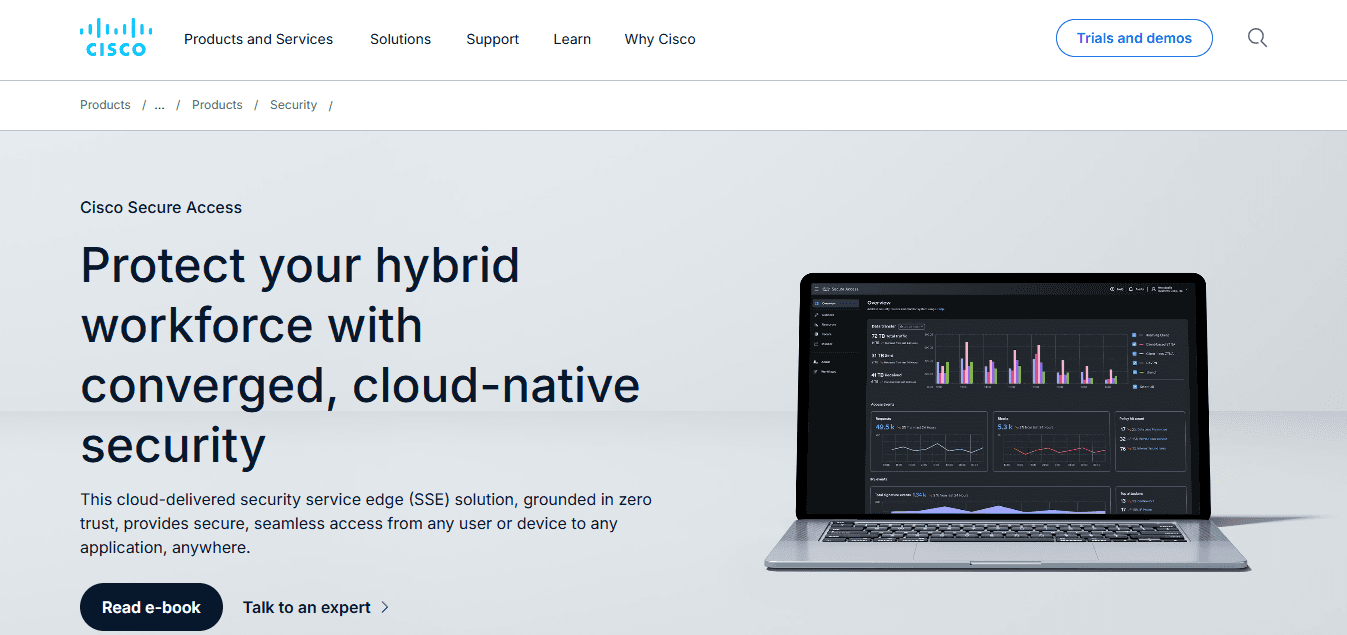
The same issue surfaces in organizations that have already standardized on Cisco networking: security tools that do not integrate with existing infrastructure create management overhead that compounds over time. Cisco Secure Access solves that by connecting cloud security controls directly to Cisco's broader ecosystem, so policy changes propagate consistently across the network rather than requiring manual updates in separate consoles.
Its DNS-layer security adds a layer of protection that most DLP-focused platforms ignore entirely. Blocking malicious destinations at the DNS level stops data exfiltration attempts before a connection is even established, which is a fundamentally different approach from inspecting traffic after it has already left the network.
8. Skyhigh Security
SaaS application sprawl is one of the most underestimated data risks in modern organizations. Employees adopt new cloud tools faster than security teams can evaluate them, and sensitive business data moves into those applications without any visibility or control. Skyhigh Security was built to address that specific problem, providing detailed visibility into which cloud applications are in use, what data is being shared through them, and whether those applications meet the organization's security standards.
According to the Nightfall AI Blog, 12 of the best data loss prevention software solutions have been identified for 2025, reflecting how much the market has expanded as cloud security demands have grown. Skyhigh's strength is that it not only detects shadow IT. It gives security teams the context to make informed decisions about which applications to allow, restrict, or block entirely.
9. Proofpoint Information Protection
Email remains the highest-risk channel for sensitive data exposure, due to both accidental sharing and deliberate insider threats. Proofpoint Information Protection focuses on that channel with a level of specificity that general-purpose DLP platforms rarely match. Its behavioral analytics engine learns normal communication patterns and flags deviations that suggest a user is either about to make a costly mistake or is actively moving data outside approved boundaries.
The insider threat detection capability is particularly relevant for organizations going through workforce transitions. Departing employees represent a concentrated data risk during their final weeks, and Proofpoint's monitoring captures that window with policy enforcement that triggers automatically rather than waiting for a manual review.
10. Digital Guardian

If your organization handles regulated data in sectors like healthcare, finance, or defense contracting, the tolerance for data exposure is essentially zero. Digital Guardian was built for that environment. It combines endpoint DLP with continuous behavior monitoring, which means it tracks how sensitive data is being used at the device level, not just whether it crossed a network boundary.
AI-Assisted Spreadsheet Classification
Most teams handling sensitive data at that level still rely on spreadsheets to track classification decisions, remediation actions, and compliance status across hundreds of findings. That workflow works until the volume of findings exceeds what a spreadsheet can realistically manage.
Teams looking to bring AI-assisted categorization into that process without adopting an entirely new platform often use Numerous's spreadsheet AI tool, which runs directly inside Google Sheets or Excel using a simple =AI function. It helps analysts classify, tag, and organize large datasets without leaving the tools they already use and without the setup complexity that enterprise platforms require.
How to Think About the Decision
The challenge is not finding a platform. The challenge is knowing which one fits your specific environment without discovering the gaps after deployment.
Fit Assessment Over Feature Comparison
The right framework is not a feature comparison. It is a fit assessment.
Start with your highest-risk data types
Identify where they live and how they move
Evaluate which platform provides the most accurate detection and the least operational friction for that specific pattern
A platform that excels at cloud DLP but struggles with endpoint coverage is not a universal solution. It is a partial one.
Constraint-Based Platform Selection
Constraint-based thinking helps here.
If your team is small and your budget is limited, platforms with complex policy engines and lengthy onboarding cycles will cost you more in lost productivity than they save in risk reduction.
If your environment is primarily Microsoft 365, deploying a third-party DLP platform that partially integrates with it adds complexity without proportional benefit.
The best platform is always the one your team can actually operate consistently, not the one that looks most impressive in a vendor presentation.
Know The Coverage Gaps
The question most teams skip is not "what does this platform protect?" but "what does it miss, and how would we know?" Every platform has coverage gaps. The difference between a good selection and a costly one is whether you discovered those gaps before or after signing the contract.
Related Reading
The 20-Minute Workflow to Evaluate Nightfall AI Alternatives

Structured evaluation separates teams that choose confidently from teams that choose twice. The difference is not time spent; it is the sequence followed.
Define Your Data Protection Requirements First
Before you open a single vendor comparison page, you need a clear picture of what you are actually protecting. Not a vague sense of sensitive data, but specifics:
Customer PII
Financial records
Source code
Employee data
Regulated health information
The platforms that look identical in a demo start separating quickly once you hold them against a concrete list of what your organization actually handles.
Write it down. Seriously. A one-page document listing your sensitive data types, where they live, and which cloud applications touch them will do more to accelerate your evaluation than any feature matrix. Without it, every platform appears to solve your problem because you have not defined what your problem actually is.
Map Your Cloud Application Footprint
The failure point is usually not the platform itself; it is the mismatch between what the platform monitors and where your data actually moves. A tool that covers Microsoft 365 in depth but misses your GitHub repositories or Slack channels leaves real exposure. Your cloud application footprint is not a nice-to-have input for evaluation; it is the filter that eliminates half the field before you read a single datasheet.
According to a Nightfall AI press release via PR Newswire, 77% of employees use AI tools at work without IT approval. That number tells you something important: your data footprint is almost certainly larger and messier than your official inventory suggests. Any platform evaluation that does not account for unsanctioned AI usage is evaluating a smaller problem than the one you actually have.
Identify Your Compliance Requirements Before Comparing Features
The pattern that surfaces in both enterprise security teams and lean startup environments is the same: compliance requirements are treated as an afterthought rather than a primary filter. Teams spend weeks comparing detection accuracy and dashboard UX, then discover late in the process that a platform does not support the specific framework their legal team requires.
The DeepInspect buyer evaluation references two primary compliance frameworks, EU AI Act Article 12 and NIST AI RMF, as the anchors for evaluating AI-era DLP platforms. If your organization operates under either of those frameworks, or under HIPAA, SOC 2, GDPR, or CCPA, that requirement needs to sit at the top of your evaluation criteria, not at the bottom of a vendor questionnaire.
Compare Core Detection Capabilities Against Your Specific Data Types
The strongest platform is not the one with the broadest detection library. It is the one whose detection is most accurate for the data types your organization actually manages. A platform with 500 pre-built classifiers is only useful if the classifiers relevant to your environment work reliably.
When comparing Nightfall AI alternatives, test detection against your own sample data rather than synthetic demos. Ask each vendor how their classification handles unstructured data, how they manage false positive rates, and what happens when a policy triggers on a file that should not have been flagged. The answers reveal operational reality faster than any feature list.
Evaluate Operational Fit, Not Just Security Capability
A platform that requires three full-time administrators to maintain is not a security solution for a team of two. Deployment complexity, administrative workload, and the depth of integration with tools your team already uses are not secondary concerns. They determine whether the platform actually gets used or quietly becomes shelfware after the first quarter.
Most security teams handle requirements gathering and platform comparison as a single activity, which is where evaluations lose momentum. When you separate the two, requirements gathering first and platform comparison second, you eliminate poor-fit options before investing time in detailed vendor conversations. That separation is what compresses a months-long evaluation into something closer to three weeks.
Build Your Shortlist Around Fit, Not Popularity
The goal of the first twenty minutes of structured evaluation is not to pick a winner. It is to eliminate platforms that cannot serve your environment and focus your attention on those that can. Shortlisting three to five candidates based on defined requirements is a fundamentally different exercise than ranking ten platforms by feature count.
When teams use a structured cloud security framework to evaluate alternatives to Nightfall AI, including options such as Varonis, Microsoft Purview, Netskope, and others covered earlier in this guide, the shortlist almost always differs from the initial longlist. Requirements-first evaluation surfaces fit problems that feature-first evaluation hides.
Before vs. After: What Structured Evaluation Actually Changes
The before state is familiar.
You open five vendor websites
Read feature pages that all use the same language
Sit through demos that all show the same use cases
End up with a shortlist built on gut feel and whoever had the best sales rep
The after state is not more complex. It is more sequential. Defined requirements create a filter. That filter eliminates platforms that would have consumed evaluation time without ever being a real fit. The time reduction that comes from structured evaluation is not about moving faster. It is about stopping earlier on the wrong options and going deeper on the right ones.
The Data Classification Bottleneck Most Teams Underestimate
Requirement gathering often surfaces a gap that teams did not expect: the classification workflow itself. Security teams frequently discover that their existing approach to categorizing sensitive data, often a combination of manual tagging, spreadsheet-based tracking, and inconsistent naming conventions, cannot keep pace with the volume of data their cloud environment generates.
AI-Powered Classification Workflows
Most teams handle data classification by building spreadsheets that someone updates manually after a review cycle. As data volumes grow and cloud applications multiply, that spreadsheet becomes a snapshot of last month's reality, not today's.
Teams using Numerous' spreadsheet AI tool find that running AI-powered classification directly in Google Sheets or Excel, without API setup or new tooling, lets them categorize and organize sensitive data types at a pace that manual review cannot match, keeping their requirements documents current rather than stale.
The Sequencing is the Strategy
If you define requirements, map your compliance framework, identify your cloud application footprint, and then compare platforms, you are not just evaluating faster. You are evaluating better. The sequence forces clarity before comparison, which means every vendor conversation is anchored to something real rather than drifting toward whatever the vendor wants to show you.
That clarity is what makes the shortlist trustworthy. And a trustworthy shortlist is what makes the final decision defensible, not just to your team, but to the legal, compliance, and finance stakeholders who will eventually ask why you chose what you chose.
Compare Nightfall AI Alternatives Faster With Numerous
The question every security team eventually faces isn't which cloud data protection platform is best. It's about stopping the rebuilding of the same evaluation process from scratch every time a new vendor enters the conversation. That repetition is where good decisions stall and where scattered research notes replace structured thinking.
AI-Powered Vendor Comparison
Most teams handle vendor comparisons by pulling feature lists into separate tabs, manually cross-referencing compliance documentation, and rebuilding the criteria columns each time a new Nightfall AI alternative emerges. That approach works once. By the third evaluation cycle, it creates inconsistencies and slows down defensible decision-making.
Teams using Numerous' spreadsheet AI tool brings all vendor research, security requirements, and comparison criteria into one spreadsheet and use AI directly inside that workflow to organize, categorize, and surface the strongest matches without switching tools or rebuilding frameworks.
Repeatable Evaluation Framework
The evaluation workflow covered in this blog already solves the hardest part. Now it just needs a repeatable home. Start with Numerous today, build your comparison framework once, and let every future evaluation run from the same organized foundation.