
For anyone who works in Excel regularly, choosing between VBA macros and Python scripts is a practical decision that affects how efficiently you complete repetitive tasks. VBA has been the default automation tool for decades, but Python's growing presence inside Excel has prompted many users to reconsider their approach. Both options have real strengths, and the right choice depends on the work's complexity, the user's technical background, and how much flexibility the workflow demands.
Understanding how these two tools compare on speed, readability, and long-term maintainability makes it easier to commit to a direction without second-guessing later. For those who want to explore what AI-assisted automation can do inside a spreadsheet without writing code from scratch, Numerous is a reliable starting point available at this Spreadsheet AI Tool.
Table of Contents
Why People Struggle to Understand Python in Excel and VBA Together
The Hidden Cost of Treating Python in Excel as a VBA Replacement
Python in Excel vs VBA: Which Is Better for Automation?
The 20-Minute Workflow to Split a Task Between Python and VBA
Skip the Python-Versus-VBA Decision With Numerous
Summary
Python in Excel runs inside a Microsoft-managed cloud container, which means it cannot save files, move folders, trigger external applications, or interact with the local system. VBA, by contrast, runs locally and handles all of those actions directly. These are not two versions of the same tool. They operate under completely different architectural rules, and treating them as interchangeable is the root cause of most failed automation attempts.
VBA's local execution model is embedded in over 750 million Excel installations worldwide, reflecting how deeply it is woven into how organizations run recurring workflows. That reach exists because VBA reliably handles the delivery layer of automation: file saves, formatted email sends, folder movements, and scheduled triggers. Python in Excel was not designed to compete with that. It was designed to handle data transformation, statistical modeling, and visualization inside the workbook.
The hidden cost of misreading these tool boundaries is not the initial debugging time. It is the compounding effect of building downstream logic around a flawed assumption. When a workflow is designed on the belief that Python in Excel can reach the file system, every connected step (the scheduling logic, the output structure, the handoffs) gets built on that same faulty premise. Unwinding it means rebuilding not just the broken piece but everything attached to it.
Environment mismatches are another common failure point for VBA. A macro that runs cleanly on one Windows machine can fail silently on another if file paths differ, referenced libraries are missing, or security settings block execution. In browser-based Excel, VBA does not run at all, not with reduced capability, but with zero availability. Any shared workflow built entirely on VBA needs to account for this before the build, not after a colleague opens the file in a browser and nothing responds.
Rolling out Python in Excel to over 1 million Microsoft 365 users in 2024 surfaced a consistent pattern: most friction came from users expecting the tool to behave like a locally executed script. The cloud container is not a gap Microsoft will eventually close. It is the intended architecture. Bridging the two tools through VBA's Shell function is a workable option for personal, one-off scripts, but it breaks on path changes, different machines, and missing Python installations, making it a fragile foundation for anything shared or recurring.
The most reliable approach for teams working across both tools is to treat Python in Excel as the analysis engine and VBA as the delivery mechanism, with each handling only the tasks it was designed for. That division works well when both sides of the team have the technical fluency to maintain it. Switching between that split and a more accessible option is where most teams lose time.
Numerous Spreadsheet AI Tool fits into this space by letting teams run AI-powered functions directly inside Excel cells using plain language, without requiring Python knowledge, VBA scripting, or any environment configuration.
Why People Struggle to Understand Python in Excel and VBA Together
Python in Excel and VBA are not interchangeable tools. Python in Excel runs inside a secure cloud container and cannot save files, trigger system actions, or access anything outside the workbook. VBA runs locally and can automate almost any Excel behavior, but it is blocked entirely in Excel for the web and frequently disabled by corporate IT policies. Two tools, two completely separate technical boundaries, neither one a true replacement for the other.
"Two tools, two completely separate technical boundaries — neither one a replacement for the other."
Feature | Python in Excel | VBA |
|---|---|---|
Runs in | Secure cloud container | Local machine |
File access | ❌ Cannot save files | ✅ Full file system access |
System actions | ❌ Blocked | ✅ Supported |
Excel for the web | ✅ Supported | ❌ Blocked entirely |
Corporate IT risk | ✅ Lower risk | ⚠️ Frequently disabled |
💡 Tip: Before choosing between Python in Excel and VBA, always check your organization's IT policies — VBA is one of the most commonly disabled tools in enterprise environments.
⚠️ Warning: Assuming Python in Excel can replace VBA is one of the most common mistakes beginners make. These tools operate in fundamentally different environments with non-overlapping capabilities — treating them as equivalent will break your workflows.

Where does the failure point actually happen?
The failure point hits when someone tries to write a file path, trigger an email, or move a workbook to a network drive—and the feature doesn't respond. Not because the code is wrong, but because the cloud container lacks that access. The same person who writes clean pandas code for data transformation hits a wall the moment the task shifts from analyzing data to acting on it outside the spreadsheet. A developer comfortable with VBA's Shell function calls an external Python script, only to discover that hardcoded file paths break when a colleague opens the file on a different machine with a different Python installation. No error message explains the problem. The macro stops working.
What hidden cost builds up when teams use the wrong tool?
Most teams use whatever tool they already know, then push it past its intended purpose. The hidden cost accumulates quietly: hours spent fixing a Python-in-Excel script that never reaches the file system, or a VBA macro that works on one machine and fails silently on another. Tools like Numerous exist because this gap is real. When the goal is running AI-driven logic across spreadsheet data at scale without shell commands, hardcoded paths, or cloud container restrictions, a purpose-built function inside the cell removes the architectural friction entirely.
What are the three distinct approaches being conflated here?
There are three ways people use "Python in Excel VBA." The first is the built-in Python in Excel feature, designed for data analysis inside a cloud container. The second is VBA's Shell-based workaround, which starts an external Python script but returns nothing to Excel and breaks when file paths don't match. The third is a dedicated local integration tool that connects the two environments.
Which specific job should determine which tool you pick?
The key difference isn't which language you prefer, but what you're trying to do before picking a tool. Data cleaning, modeling, and chart generation belong to Python in Excel. File automation, workbook formatting, and system-level triggers belong to VBA. Forcing either one into the other's territory creates a weak process that works until it doesn't, usually at the worst possible moment. But the real cost of getting this wrong extends beyond wasted debugging time, which surprises most people.
Related Reading
How To View Hidden Sheets In Excel
Vba Excel Examples
Python In Google Sheets
Google Sheets VBA
How To Connect Google Sheets To Crewai
How To Connect Google Sheets To Langchain
Can You Group Sheets In Excel
The Hidden Cost of Treating Python in Excel as a VBA Replacement
The real cost isn't the time spent fixing bugs. It's the confidence that builds up around a broken approach — the quiet certainty that you're one more small change away from making it work, right up until you discover the feature was never designed to do what you've been asking it to do.
"The most dangerous assumption in any tool migration is that familiar syntax means equivalent capability — it doesn't." — Engineering Principle
⚠️ Warning: The hidden cost of misusing Python in Excel as a VBA replacement isn't measured in hours lost — it's measured in false confidence and compounding technical debt that quietly grows beneath the surface.
Approach | Short-Term Feel | Long-Term Reality |
|---|---|---|
Treating Python as VBA | Familiar, fast to start | Hits hard limits, breaks unexpectedly |
Learning Python's actual model | Steeper initial curve | Scalable, reliable, future-proof |
Sticking with VBA | Comfortable, known | Legacy risk, limited modern integration |
🎯 Key Point: The most expensive bugs are the ones you never see coming — the ones hidden behind a workflow that almost works, until it catastrophically doesn't.
💡 Tip: Before investing hours in a Python-in-Excel solution, ask one critical question: "Was this feature explicitly designed for this use case?" If the answer is unclear, stop and verify before building further.

When the wrong mental model drives the build
The failure point is usually invisible at the start. A developer or analyst picks up Python in Excel, recognizes the familiar syntax, and starts designing a workflow that assumes the tool carries Python's full reach into the file system and operating environment. The workbook gets built, the logic gets refined, and then the wall appears: not a bug or fixable error, but a structural boundary that no amount of clever code will move. According to the Ali Jabbary Blog's 2026 analysis of switching from Excel and VBA to Python, moving recurring reports from Excel and VBA to Python takes roughly two weeks—a meaningful investment to lose because the tool's scope was misread from the beginning.
Why does sharing a host application not mean sharing capability?
The same pattern shows up in both small teams and large ones: the idea that using the same host application means having the same ability. Python in Excel and VBA both live in Excel, but one runs in a cloud container with clear limits on system access, while the other runs locally with broad reach but no presence in browser-based sessions. Treating them as the same is like assuming two employees in the same building have the same security clearance.
What happens when teams stretch a familiar tool past its limits?
Most teams use whatever tool they already know, then stretch it to cover tasks it was never built for. The familiar approach feels efficient until the workflow breaks in unexpected ways, often on someone else's computer or in a browser session where VBA simply doesn't load. Tools like Numerous take a different path, letting teams run AI-powered functions directly inside Excel or Google Sheets without touching macro configurations or cloud container restrictions. When the goal is generating, classifying, or transforming content at scale, that no-setup access removes the capability mismatch before it starts.
What the rebuild actually costs
The critical difference between getting this right early and getting it wrong late is the compounding effect of decisions made downstream from a flawed foundation. When a workflow assumes Python in Excel can handle file saves and system triggers, every subsequent step—scheduling logic, output structure, handoffs to other tools—gets designed around that assumption. Unwinding it requires rebuilding not just the broken piece but everything connected to it.
Why is the division of labor between these tools a feature, not a flaw?
The division of labor between these two tools is not a limitation to work around; it's a design decision that makes both more useful. Python in Excel handles data transformation, statistical modeling, and visualization. VBA handles the local automation layer: file movements, formatting triggers, and email sends (assuming your environment allows it). Each excels at its specific job. The cost comes from expecting either one to cover the other's ground. Once you understand where each tool's authority ends, a sharper question emerges: when automation is the goal, which one gives you more reliable control?
Related Reading
How To Use Python In Excel
How To Connect Excel To LangChain
How To Compare Two Excel Sheets Using VLOOKUP
How To Combine Multiple Excel Sheets Into One
How To Add VBA To Excel
How To Build Agentic Workflows
Integrate Agent With Google Sheets
How To Delete Multiple Sheets In Excel
Best Python Tools For Excel
Data Visualization With Python In Excel
Python in Excel vs VBA: Which Is Better for Automation?
For automation, VBA wins structurally. Python in Excel runs in an isolated cloud container that cannot save files, move folders, trigger external applications, or interact with your system. VBA runs locally and can do all of that—what real automation requires.
"Python in Excel's isolated cloud environment is powerful for analysis—but it's structurally limited when it comes to the file system access and system interactions that true automation demands."
🎯 Key Point: For true end-to-end automation—moving files, triggering apps, scheduling tasks—VBA is the only viable choice between these two tools.
⚠️ Warning: Don't assume Python in Excel can replace VBA for automation workflows. Its sandboxed cloud container is a fundamental architectural limitation, not a bug that will be patched.

VBA's dominance reflects this practical reality. According to Excelgoodies, VBA is used in over 750 million Excel installations worldwide. This massive reach exists because VBA handles the core automation tasks: saving files on a schedule, moving data between folders, sending formatted emails, and triggering actions outside the workbook. These are not edge cases—they are what most people mean by "automate this."
Capability | Python in Excel | VBA |
|---|---|---|
Save files automatically | ❌ Not supported | ✅ Full support |
Move/manage folders | ❌ Not supported | ✅ Full support |
Trigger external applications | ❌ Not supported | ✅ Full support |
Send formatted emails | ❌ Not supported | ✅ Full support |
Advanced data analysis | ✅ Best-in-class | ⚠️ Limited |
Cloud container isolation | ✅ Secure by design | ❌ Runs locally |
Interact with local file system | ❌ Blocked | ✅ Full access |
🔑 Takeaway: With over 750 million installations, VBA's dominance isn't legacy inertia—it's a direct reflection of the fact that VBA does what automation actually demands: local access, scheduled execution, and system-level control that Python in Excel simply cannot match.
What Python in Excel actually controls
Python in Excel handles data transformation, statistical modeling, and visualization in ways that VBA cannot match. However, Excelgoodies also reports that over 1 million Microsoft 365 users encountered problems in 2024 because they expected it to work like scripts on their own computers. Microsoft won't fix the cloud container; it is how the system is built. Expecting Python in Excel to move files around is like expecting a calculator to send an email.
How do most teams bridge Python in Excel with VBA?
Most teams handle this by using Python in Excel as their analysis engine and VBA as their delivery mechanism. Python runs the analysis, the output goes to VBA, and VBA moves it where needed. This workflow requires technical skill on both sides and creates a barrier for anyone unfamiliar with macros or cloud execution. Tools like Numerous offer an alternative: our spreadsheet AI tool lets you run prompts directly inside Excel cells using a simple function, without requiring Python knowledge, VBA scripting, or configuration overhead.
When VBA's local power becomes a liability
The failure point is usually environment mismatch. VBA runs locally, which gives it power, but that same locality means it breaks when the environment changes. A macro that works perfectly on one machine can fail silently on another if the file paths differ, the referenced libraries are missing, or security settings block execution. In browser-based Excel, VBA does not run at all. Any workflow built entirely on VBA needs to account for this upfront, not as an afterthought when a colleague opens the file in a browser and nothing works.
What happens when your team works across different environments?
If your workflow lives entirely inside a single, consistent Windows environment, VBA gives you reliable, deep automation control. When your team works across operating systems, uses browser-based Excel, or needs to share macros with different local configurations, VBA's local execution model becomes a coordination problem. Python in Excel does not solve that problem either, since its cloud container introduces its own restrictions. Neither tool was designed as a universal automation solution: knowing exactly where each one breaks separates a workflow that holds from one that fails silently at the worst possible moment. Once you understand where each tool's authority ends, the next question is: how do you decide which part of a task belongs to which tool?
The 20-Minute Workflow to Split a Task Between Python and VBA
Most people skip mapping out their task before building, picking a tool based on what they know rather than what works best—then spend hours fixing problems in a mismatched workflow. The 20-minute workflow below fixes that by turning the Python-versus-VBA boundary into a concrete checklist applied to your specific task, so each step gets the right tool before you write a single line.
"Choosing the wrong tool at the start of a project doesn't just slow you down—it creates compounding rework that can cost hours of debugging a fundamentally mismatched architecture." — Workflow Engineering Best Practices
💡 Tip: Before writing any code, invest 20 minutes in tool-mapping. The upfront cost is tiny compared to the hours lost refactoring a mismatched workflow later.
⚠️ Warning: Defaulting to the tool you're most comfortable with is the #1 mistake developers make when splitting tasks between Python and VBA—comfort is not the same as fit-for-purpose.
Decision Factor | Choose Python | Choose VBA |
|---|---|---|
Data volume | Large datasets, complex transforms | Small, contained Excel ranges |
Automation scope | Cross-platform, external APIs | Native Excel/Office automation |
Logic complexity | Advanced algorithms, ML, parsing | Formatting, cell manipulation |
Deployment target | Servers, scripts, pipelines | End-user Excel workbooks |
Speed priority | Batch processing at scale | Instant in-workbook execution |

Minute 0-5 List Every Distinct Step
Write out each individual action your workflow requires: not the outcome, but the steps. Cleaning a dataset, building a pivot chart, saving a report to a shared drive, sending it to a distribution list. Each one gets its own line. The failure point is treating a multi-step workflow as a single task. When you collapse five distinct actions into one vague goal, you default to one tool for all of them, and that's where the mismatch begins.
Minutes 5-10 Sort Each Step by Type
Go through your list and mark each step as either data analysis (cleaning, modeling, transforming, charting) or automation (saving, formatting, emailing, triggering external actions). Use two columns, one decision per row. This puts the documented division of labor into action: you run a checklist against your actual task, and the categories make the decision for you.
Minutes 10-15: Check Your Excel Environment
Before you build anything, confirm whether you're working in desktop Excel, Excel Online, or a managed corporate environment with IT restrictions, since that determines whether VBA is available. A common pattern: someone builds a VBA-dependent workflow locally, shares the file, and watches it break silently in a browser session or locked corporate environment. Catching this early costs nothing; catching it after two weeks of builds costs real time.
Minutes 15-20: Decide How to Bridge, If You Need To
If your workflow needs both Python and VBA working together, decide whether a Shell-based call suits a personal, one-time script, or whether a local integration layer like xlwings Lite justifies the setup time for shared or recurring work.
Why does the Shell approach fail when it matters most?
The Shell approach is fragile by design. It works until the Python installation path changes, the file moves, or a colleague opens it on a different machine. Choosing it deliberately, knowing the tradeoff, is fine. Choosing it by default because it was the first search result is how workflows fail quietly at the worst moment.
Where does the real cost of Python-in-Excel VBA integration show up?
This is where the complexity of Python-in-Excel VBA integration reveals its true cost: not in the scripting itself, but in the coordination overhead needed to maintain it across different users, machines, and permission levels. Teams seeking AI-assisted outputs in their spreadsheets without that overhead increasingly turn to our Spreadsheet AI Tool, Numerous, which brings AI directly into Excel and Google Sheets through simple function syntax and eliminates the bridging problem entirely. There's no Shell call to maintain, no Python environment to configure, and no VBA dependency to check. The AI layer lives inside the cell, accessible to anyone on the team without setup.
Why the Order Matters
The order is not random. Steps one and two ensure you understand the task clearly before using any tool. Step three identifies environment limits before they become build problems. Step four transforms the bridging tradeoff from something unclear into a deliberate choice. When you pick a tool first and figure out the task later, you end up retrofitting. Retrofitting a workflow around a tool's limits always costs more than designing around them from the start.
Before and After the Checklist
Before: one tool chosen for an entire multi-step task, VBA assumed available without an environment check, a Shell-based bridge treated as permanent despite its documented fragility. After each step is sorted by type, the environment is confirmed, and a bridging approach is chosen based on whether the workflow is personal or shared. The improvement comes from applying a structured decision to your specific task before writing code.
What does catching the mismatch early actually cost you?
The checklist takes twenty minutes. The alternative—finding the mismatch after the build—takes much longer, and the cost is rarely time alone. But what if the smarter move wasn't choosing between Python and VBA at all?
Skip the Python-Versus-VBA Decision With Numerous
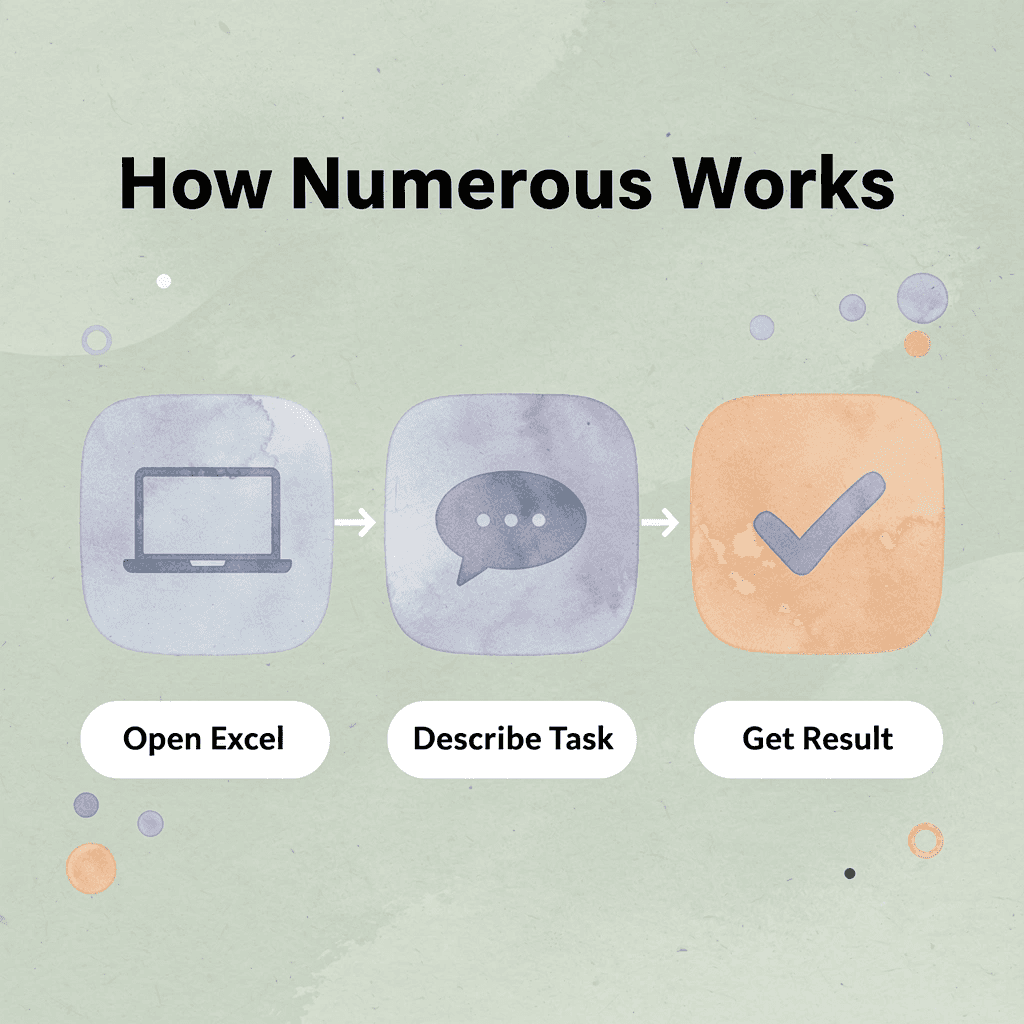
That question about skipping the choice entirely has a practical answer. Numerous lets you open the plugin inside your existing Excel sheet, describe what you need in plain language, and get the result without writing a single line of Python or VBA. Our spreadsheet AI tool eliminates the tool-selection step entirely — because the task itself no longer requires it.
💡 Tip: Instead of spending time deciding which language to use, Numerous lets you describe the task plainly and delivers the result in about a minute — no syntax, no setup, no switching tools.
"The best tool for the job is the one that gets it done fastest — and sometimes, that means skipping the code entirely." — Numerous
Approach | Setup Required | Coding Knowledge Needed | Speed |
|---|---|---|---|
Python in Excel | ✅ Environment + libraries | ✅ Intermediate–Advanced | 🐢 Slower |
VBA | ✅ Macro editor + syntax | ✅ Intermediate | 🐢 Slower |
Numerous (AI) | ❌ None | ❌ None | ⚡ ~1 Minute |
🔑 Takeaway: For the vast majority of everyday Excel tasks, Numerous removes the Python-versus-VBA decision completely — replacing it with a plain-language description and an instant result.

The people getting the most done in Excel strategically match each task to the simplest tool that completes it, saving Python in Excel and VBA for work that genuinely needs those capabilities: complex statistical modeling, local file automation, or system-level triggers. For everything else, describing the task plainly and reviewing the output takes about a minute, compared with the setup time that even a well-understood Python-versus-VBA split still demands.
⚠️ Warning: Don't default to Python or VBA out of habit. Reaching for a heavy tool for a simple task wastes time that AI-assisted workflows can reclaim instantly.
Try Numerous against your own workbook with a $1, seven-day trial, then save Python in Excel and VBA specifically for tasks that need them.
✅ Best Practice: Use Numerous for everyday automation, reserve Python for complex statistical modeling, and keep VBA only for system-level or local file triggers. This stack maximizes output with minimal friction.
Related Reading
Trullion Alternatives
Datasnipper Alternatives
Top Autonomous Agents For Web Research
Ai Agents For Multi-step Tasks With No Coding
Lido Alternatives
Suralink Alternatives