
Sending a multi-sheet Excel workbook to a client can be frustrating when they cannot navigate tabs the way the creator can. Combining multiple Excel sheets into a single PDF keeps data clean, professional, and accessible without requiring the recipient to open Excel. Whether the workbook contains financial reports, project trackers, or any multi-sheet dataset, exporting everything into one file is straightforward once the steps are clear.
The process becomes even more efficient when you handle repetitive formatting tasks before export. Rather than manually adjusting print areas and checking page breaks across every sheet, automation tools can prepare the data so it compiles into a polished PDF in far less time. For teams looking to streamline this further, Numerous is a Spreadsheet AI Tool built to handle exactly that kind of workflow.
Table of Contents
Why People Struggle to Save Multiple Excel Sheets as One PDF
The Hidden Cost of Skipping the Export Scope and Page Setup Check
The 15-Minute Workflow to Combine Sheets Into One PDF Correctly
Summary
Excel's default export behavior silently exports only the active sheet, even when you select multiple tabs, because a separate setting in the Options dialog controls the export scope rather than tab selection. This disconnect causes most failed multi-sheet PDF attempts, and Excel provides no warning or error message, so the wrong output lands without any indication that something went wrong.
Page setup consistency across sheets involves three independent variables, not two. Most users check paper size and orientation, consider the job done, and move on. But scaling method is a separate setting, and a sheet set to "Fit to 1 page" alongside a sheet set to 85% scaling will produce visibly different page dimensions in the final PDF even when paper size and orientation are identical across both.
The system-level default printer is a documented but widely overlooked cause of export failures. When an unusual device such as a label printer or XPS writer is set as the system default, Excel's PDF export can inherit that device's page dimensions instead of the paper size defined in each sheet's page setup. Nothing inside Excel's export interface points to the printer as a possible cause, which is why it consistently goes undetected through multiple failed attempts.
A Microsoft Q&A thread on multi-sheet PDF failures documents five distinct causes: version conflicts, file format issues, print settings mismatches, pending updates, and add-ins or macros interfering with the export. Each cause can independently produce an incorrect result, and none trigger a visible error in the final PDF, so users must work backward from the output to identify which setting failed.
Validation after export is the step most often skipped under time pressure, and it catches what every earlier check was designed to prevent. Completing an export without errors does not confirm the output is correct. A 30-second scroll through the finished PDF to verify page count, sheet order, and layout consistency is the only way to confirm the export matched the intent.
Repeatable processes matter more than one-time accuracy. The failure point in multi-sheet exports is rarely the first attempt. It is the third or seventh attempt, made under deadline pressure, when a checklist gets skipped because the previous export worked. Page setup mismatches and incorrect export scope do not announce themselves, and a workflow that depends on memory rather than a fixed sequence will eventually produce a quietly wrong file.
Numerous Spreadsheet AI Tool addresses this by letting users run AI-assisted checks on formatting consistency across all sheets directly inside their existing workbook, replacing the manual tab-by-tab review that slows down the final export step.
Why People Struggle to Save Multiple Excel Sheets as One PDF
Excel's default export behavior causes most multi-sheet PDF failures without any warning. When you click File → Export → Create PDF/XPS without opening the Options dialog, Excel defaults to "Active Sheet" no matter how many tabs you've selected—producing a single-sheet PDF with no warning or error message.
"Excel silently defaults to exporting only the Active Sheet, meaning users can unknowingly produce an incomplete PDF every single time they export without adjusting the Options dialog." — Excel Export Behavior, Microsoft Documentation
⚠️ Warning: This is the #1 silent mistake Excel users make — you can select every tab in your workbook and still end up with a one-page PDF because Excel never tells you it ignored your selection.
💡 Tip: Always open the Options dialog before exporting. This single step is the critical difference between a complete multi-sheet PDF and a frustratingly incomplete one.
Export Behavior | What Excel Does | Result |
|---|---|---|
Skip Options dialog | Defaults to Active Sheet | Single-sheet PDF |
Open Options dialog | Lets you select Entire Workbook | Complete multi-sheet PDF |
Pre-select tabs only | Ignored without Options change | Single-sheet PDF |

Why does selecting multiple tabs not control the export scope?
The selection behavior is tricky. Selecting multiple sheet tabs works for grouped editing, formatting, and data entry, so it seems the same selection would control what gets exported. It doesn't. A separate setting in the Options dialog controls export scope. Unless you manually change it to "Entire Workbook" or a specific selection, Excel exports only the active sheet.
What documented causes produce a failed or incomplete PDF export?
According to a Microsoft Q&A thread on multi-sheet PDF save failures, five documented causes exist: version conflicts, file format issues, print settings mismatches, pending updates, and add-ins or macros interfering with export. Each can independently produce the wrong result without triggering a visible error.
Page setup consistency is the second failure point. If two sheets share the same paper size but use different scaling methods—one set to "Fit to 1 page" and another to "100% of normal size"—the resulting PDF shows visibly different page dimensions. Most people check paper size and orientation, but scaling type is a separate variable that creates subtle inconsistencies in the final PDF.
Why does printing to PDF leave you with multiple separate files?
Most teams export sheets one at a time and manually combine files, which works until the workbook grows or deadlines tighten. According to a Microsoft Q&A answer by Kurt, the Print to PDF method generates one unique file per worksheet rather than combining them, leaving multiple files to merge. Our Numerous spreadsheet AI tool automates formatting and preparation tasks directly inside Excel before export, so the workbook arrives consistent rather than requiring manual sheet-by-sheet checks.
How can the default printer silently affect PDF page dimensions?
The default printer is the least obvious factor. Documented reports confirm that an unusual default printer—such as a label printer or XPS-format device—can cause Excel's PDF export to inherit that printer's page dimensions instead of standard sizing. Excel's export interface doesn't indicate that the printer could be the culprit.
Skipping these checks can cost far more than a few minutes of frustration.
Related Reading
How To View Hidden Sheets In Excel
Vba Excel Examples
Python In Google Sheets
Google Sheets VBA
How To Connect Google Sheets To Crewai
How To Connect Google Sheets To Langchain
Can You Group Sheets In Excel
The Hidden Cost of Skipping the Export Scope and Page Setup Check
Skipping the export scope check creates a dangerous pattern: the wrong output becomes the default, and the cost adds up with every repeated attempt, every time you reopen the dialog, and every moment spent wondering why the file looks different from what you selected.
"The most expensive mistakes in document workflows aren't the ones you notice immediately — they're the ones that repeat silently every single time you hit export." — Workflow Efficiency Principle
⚠️ Warning: A single skipped scope check doesn't just cost you one bad export — it embeds a broken default into your workflow that compounds with every future attempt.
Skipping the Check | Running the Check |
|---|---|
Wrong output becomes the default | Correct scope is confirmed every time |
Repeated wasted attempts | First-time accuracy on exports |
File looks different from selection | File matches exactly what you selected |
Time lost reopening the dialog | Zero rework required |
💡 Tip: Before every export, take 5 seconds to verify your scope and page setup settings — this single habit eliminates the entire cycle of repeated attempts and unexpected output errors.

Why does the failure only show up after the damage is done?
The failure point is usually invisible until after the damage is done. You export, open the PDF, and discover that three sheets are missing or that page five looks noticeably narrower than the rest. No error message. No warning. Just a quietly wrong file in your downloads folder. That silence makes this mistake expensive in practice, because there's no signal telling you where to look next.
The same issue surfaces in pricing decisions and spreadsheet exports: hidden costs only become visible after the outcome lands. According to a LinkedIn analysis by Paresh Solanki on export pricing, a perceived profit of $2 per unit can be reduced to nearly $0 after accounting for real costs like freight, packaging, and other charges that weren't visible at the decision point. In Excel, what appears complete collapses once you account for unchecked settings. The cost was always there—it simply wasn't visible until the output arrived.
How does scaling method create problems that paper size alone won't catch?
Most people who work across multiple sheets in Excel check paper size and orientation, then move on. But when combining sheets into one PDF, scaling method becomes a third, independent variable that paper size and orientation don't cover. One sheet set to "Fit to 1 page" and another set to 85% scaling will produce visibly different page widths in the final document, even with identical paper size and portrait orientation. Power users who benefit from tools like Numerous, which bring AI directly into Excel to automate and organize at scale, face this problem more often because they have more sheets to align and more opportunities for settings to drift.
The default printer issue operates outside Excel's interface. When an unusual device, such as a label printer or XPS writer, is set as the system default, Excel's PDF export can inherit that device's page dimensions instead of the paper size defined in page setup. The fix requires leaving Excel, checking the operating system's printer settings, and resetting the default to a standard printer. Nothing in the export dialog indicates this.
Why does checking two out of three settings still produce a wrong result?
Saving multiple Excel sheets as one PDF is controlled by three separate settings: export scope in the Options dialog, page setup consistency across every sheet including scaling method, and the system-level default printer. Each works independently, and checking two out of three still produces incorrect results. The only way to identify which setting caused the problem is to open the PDF and work backward from what went wrong.
The real question is whether you have a reliable, repeatable process for checking all of them before you export.
How to Save Multiple Excel Sheets as One PDF in 15 Minutes
The seven steps below are intentionally ordered. Each one addresses a specific failure point, and skipping any step — like skipping step two because you completed step one — is exactly how a 30-sheet workbook ends up as a one-page PDF.
"Skipping even a single step in a structured workflow is the #1 reason multi-sheet Excel exports fail silently — leaving users with incomplete PDFs and no clear error message." — Excel Power User Best Practices
💡 Tip: Follow the steps in exact order — each one is designed to prevent a specific failure that the previous step alone cannot catch.
⚠️ Warning: Do not skip step two just because step one succeeded. These steps are interdependent, and out-of-order execution is the most common reason a full workbook collapses into a single-page PDF output.
Step | What It Addresses | Skip Risk |
|---|---|---|
Step 1 | Initial sheet selection | Missing sheets in output |
Step 2 | Print area configuration | Single-page PDF collapse |
Step 3 | Page layout alignment | Cut-off or misformatted pages |
Step 4 | Print settings verification | Wrong paper size or orientation |
Step 5 | Preview check | Undetected formatting errors |
Step 6 | Export execution | File save failures |
Step 7 | Output validation | Silent export errors |

Select your sheets first, then confirm scope
Hold Ctrl and click each tab you want included, or hold Shift and click the first and last tab for a continuous range. This defines the group Excel references during export, but it doesn't automatically set the export scope. These are separate decisions, and confusing them causes most failed exports.
After selecting your sheets, go to File > Export > Create PDF/XPS, then click Options. Set the scope to "Entire Workbook" or "Selection" depending on your needs. ExcelDemy's 2024 breakdown of the 6 methods for saving multiple Excel sheets as one PDF confirms that the Options dialog controls scope separately from tab selection.
Match page setup across every sheet
The failure point is usually invisible until the PDF opens. Two sheets with different paper sizes or orientations will split into separate files instead of combining, and Excel provides no advance warning.
Check the Page Layout tab on each sheet you are combining. Confirm that Size, Orientation, and Scale to Fit match across all of them. A sheet set to "Fit to 1 page" and a sheet set to 85% will produce visibly different page dimensions in the final file, even if the paper size and orientation are identical.
Rule out the default printer
Most troubleshooting stops at Excel's own settings, which is why the default printer issue persists. A label printer or XPS printer set as the system default can alter page dimensions and layout in ways unrelated to the application itself.
If your export still looks wrong after checking scope and page setup, change your system's default printer to a standard printer or "Microsoft Print to PDF," then export again. This step happens outside Excel, so it's easy to miss.
Preview before you commit
Ctrl+P shows you page breaks and layout across all selected sheets before the file is generated. Most people skip this step, but it's essential: Print Preview catches gaps between what settings say and what the export will produce. A scaling conflict that looked correct in the Page Layout tab often becomes visible immediately. Thirty seconds here saves the time it takes to reopen, fix, and re-export.
Where AI fits into a multi-sheet workflow
Manual management works with three sheets but becomes problematic across fifteen or twenty sheets with different data ranges and formatting.
Power users working across multiple sheets benefit from AI integration. Numerous lets you run ChatGPT directly inside Excel and Google Sheets without an API key, automating the organizing, labeling, and structuring work before export. The spreadsheet becomes a place to process data at scale, not store it.
Verify the final file, not just the process
A file that exports without errors does not mean the export is correct. Open the PDF and check that it includes every sheet you wanted, in the right order, with consistent page sizing throughout.
According to Microsoft Q&A community answers, which received 20 upvotes for recommending the Shift/Ctrl grouping method, the grouping step is essential. Checking your work after export completes the process, since stopping at "export complete" trusts the tool over what it produced.
What changes when you follow this sequence
Before this sequence: sheets selected, export initiated, problem discovered after opening the file. After: scope confirmed, page setup matched, printer ruled out, preview checked, output verified. The difference is checking the right things in the right order, not assuming selection alone is enough.
The gap between a correct export and a wrong one is usually a single unchecked setting. This sequence ensures none get missed.
Knowing the steps is one thing. The real test begins when you put a clock on it.
Related Reading
How To Use Python In Excel
How To Connect Excel To LangChain
How To Compare Two Excel Sheets Using VLOOKUP
How To Combine Multiple Excel Sheets Into One
How To Add VBA To Excel
How To Build Agentic Workflows
Integrate Agent With Google Sheets
How To Delete Multiple Sheets In Excel
Best Python Tools For Excel
Data Visualization With Python In Excel
The 15-Minute Workflow to Combine Sheets Into One PDF Correctly
Checking the right settings in the right order separates a clean export from a frustrating one. Following this sequence consistently ensures reliable results every time.
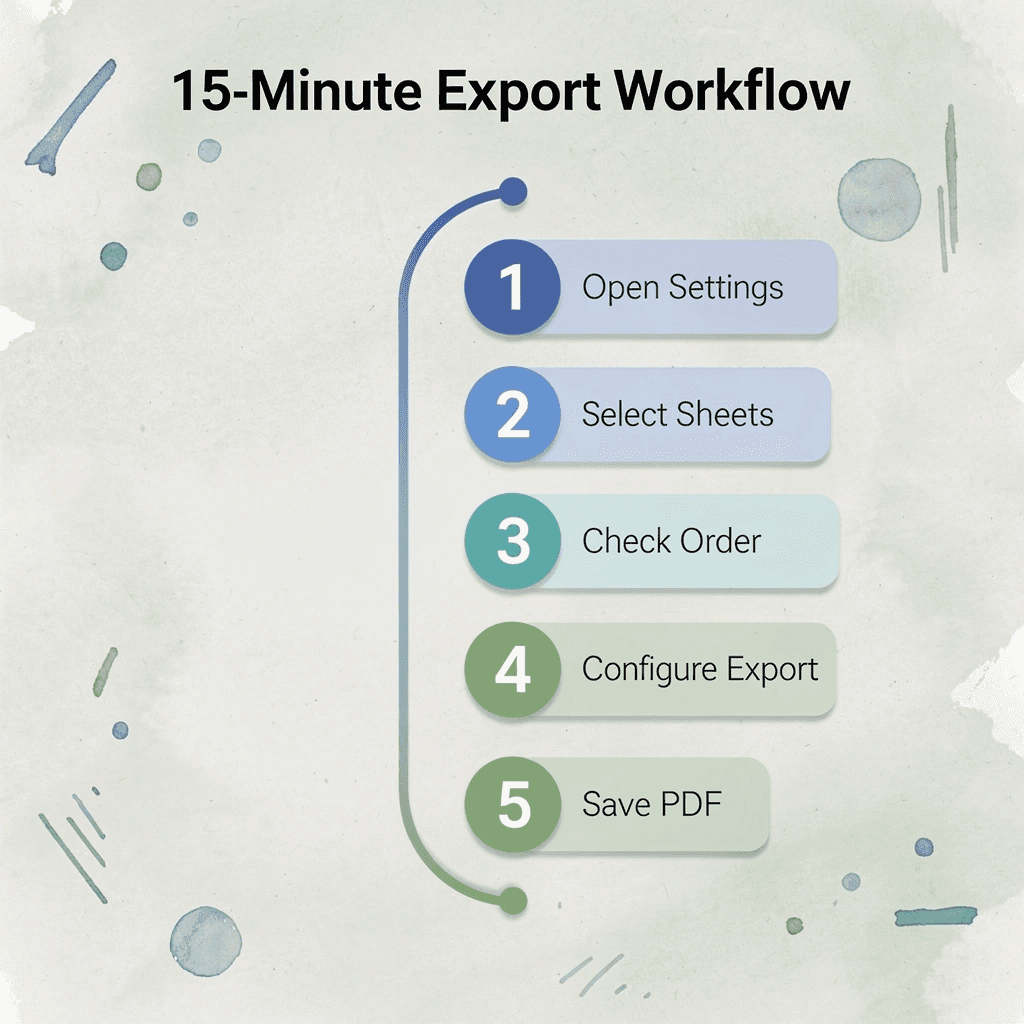
The workflow covers the mechanical steps, but not what happens when those steps need to scale, repeat, or transfer to someone else on a deadline: where the real problems emerge.
When the Process Needs to Repeat
The failure point is usually not the first export but the third or seventh, when urgency is high, and the checklist gets skipped because it "worked fine last time." Page setup mismatches and wrong export scope don't announce themselves; they hide inside a file that looks complete until someone opens it on the other end and notices a missing sheet or oddly sized page.
Repeatable processes beat good intentions every time. A single export done correctly is a success. The same export, done correctly across a team and over weeks, is a system. The gap between those two things is documentation, not skill.
What breaks when someone else runs it?
The same issue arises when a workflow passes from one person to another: the mental shortcuts don't transfer. The original creator knows to check scaling before exporting. The next person doesn't know it matters and skips it. The result is a PDF with one sheet scaled to 75% and another at full size, a mismatch visible only when printed or presented on a grid.
Why does the validation phase get dropped under pressure?
According to How To Info's guide on combining Excel files, merging Excel files requires three steps: data extraction, consolidation, and validation. The validation step, often skipped when time is tight, catches errors the other two steps miss.
The Hidden Work Inside Multi-Sheet Workbooks
Most people working across multiple sheets manage complexity beyond a single export workflow: cross-referencing data between tabs, maintaining consistent formatting, and preparing outputs for different audiences from the same file. The PDF export is the final step.
Why does the manual approach break down at scale?
The manual approach—tab by tab, check by check, export by export—works for small workbooks with forgiving deadlines. At scale, it produces inconsistent outputs, not from carelessness, but because the volume of small decisions exceeds what any checklist can reliably catch.
How does automation change the final output equation?
Tools like Numerous automate the repetitive decisions that slow down final output, without changing the underlying workflow that power users already know.
Why Validation Gets Skipped
Most people skip checking if the file is correct because the export finishes without errors. No red warning or alert appears. The file exists, so people assume it's right, but this assumption is the single most common reason a wrong PDF gets sent.
Microsoft Support's documentation on combining data from multiple sheets outlines 4 distinct methods in Excel, each with its own scope and behavior. Because Excel has no single default behavior, each method requires an explicit choice and confirmation that you made it correctly.
The Difference Between Done and Verified
Opening the finished PDF before sending it is essential: it's the only step that confirms the export matched what you wanted. A 30-second check of page count and layout catches what every earlier step was designed to prevent.
Done means the process finished. Verified means the output is correct. These are not equivalent, and conflating them turns a clean workflow into an unreliable one.
That gap between finishing and confirming is smaller than it sounds but harder to close than most people expect.
Skip the Manual Export Setup With Numerous
Open Numerous inside the workbook you're preparing to export and ask it to check paper size, orientation, and scaling across all sheets for inconsistencies. Fix anything flagged, then complete the export using the scope and verification steps covered earlier. This single check replaces manually clicking through each sheet's Page Layout tab and takes under a minute.
💡 Tip: Running Numerous before every export catches hidden formatting inconsistencies that would otherwise survive undetected into your final PDF.

"This single check replaces manually clicking through each sheet's Page Layout tab individually — and takes under a minute." — Numerous Workflow
Numerous works inside your existing workbook with no API key required, and a $1 seven-day trial lets you test it against your actual file before committing. If combining sheets into one clean, consistent PDF is your task, this is the fastest way to close the gap between finishing the export and confirming it's correct.
🎯 Key Point: At just $1 for a seven-day trial, Numerous is the lowest-risk way to eliminate manual sheet-by-sheet checks and guarantee a clean, consistent PDF export every time.
Related Reading
Datasnipper Alternatives
Suralink Alternatives
Lido Alternatives
Ai Agents For Multi-step Tasks With No Coding
Top Autonomous Agents For Web Research
Trullion Alternatives