
Connecting Python to Google Sheets lets users pull data, run calculations, and automate repetitive workflows without constantly switching between tools. Setup takes roughly 20 minutes and doesn't require a development background, making it accessible to analysts, operations teams, and anyone tired of manual spreadsheet work.
For those who want to automate spreadsheet tasks without writing Python scripts from scratch, there is a faster path. Numerous brings AI-powered automation directly into the spreadsheet environment, helping users write formulas, clean data, and run tasks at scale through a Spreadsheet AI Tool.
Table of Contents
Why People Struggle to Use Python in Google Sheets
The Hidden Cost of Assuming Native Support and an Unmaintained Library
How to Use Python in Google Sheets in 20 Minutes
The 20-Minute Workflow to Connect Python to Google Sheets
Skip the Setup Entirely for Everyday Tasks With Numerous
Summary
Google Sheets has no native Python support, and this gap underlies most failed attempts to automate spreadsheet work with Python. Every connection must run externally through the Google Sheets API, a third-party library, and a user-configured Google Cloud Platform project. Most tutorials skip or minimize this setup reality, leaving people with a structurally incorrect mental model before they write a single line of code.
Authentication is the actual bottleneck in most Python-to-Sheets setups, not the Python code itself. Setting up a Google Cloud project, enabling the Sheets API, generating a service account, and sharing the spreadsheet with that account's email address is a multi-step process that one documented source describes as "relatively painful, especially if you're new to Google's Cloud Console." People who budget 20 minutes for a quick script often spend that entire window navigating the Cloud Console before any code runs.
Library choice carries more risk than most guides acknowledge. Gspread appears in the overwhelming majority of tutorials and Stack Overflow answers, but its own GitHub repository currently carries a notice stating that maintainers are "unable to maintain" the project and are actively seeking replacements. Alternatives such as pygsheets, ezsheets, and Google's own google-api-python-client exist and are worth evaluating, but they rarely surface in the guides most people find first.
Performance limitations in Google Sheets compound the setup difficulty for users working with larger datasets. According to MCP Analytics, performance degrades noticeably above 50,000 rows, particularly when formulas, conditional formatting, and pivot tables are involved. The people most likely to pursue a Python connection are often the same ones already hitting this ceiling, meaning they face two compounding problems at once.
Sequencing the setup correctly matters more than the individual steps. Authentication, API access, spreadsheet permissions, and library installation are four separate systems that need separate confirmation. A DEV Community walkthrough notes that the full process from cloud project creation to a working Python connection takes around 20 minutes when each step is completed in order with a verification point before moving forward, but without that structure, the same steps can take significantly longer because a missed detail at step two does not surface until step five.
Apps Script is a legitimate alternative for many of the tasks people reach for Python to solve. It runs natively inside Google's environment, requires no external API credentials, handles scheduled tasks and custom menus, and is maintained by Google itself. The decision to use Python should be deliberate, not the default, especially when the goal is automation rather than access to Python's specific ecosystem.
Numerous's Spreadsheet AI Tool address the setup overhead entirely by letting users run AI-powered functions directly inside Google Sheets through a simple formula interface, with no Cloud project, credentials file, or library dependencies required.
Why People Struggle to Use Python in Google Sheets
Google Sheets does not have built-in Python support. This single fact underlies most failed attempts to connect Python to a spreadsheet. Excel's widely covered Python integration created a reasonable but incorrect assumption that Google's product works the same way.
"Google Sheets does not have built-in Python support, and the confusion with Excel's native Python integration is at the root of nearly every failed setup attempt." — Core Insight
⚠️ Warning: Don't assume Google Sheets and Excel share the same Python capabilities. This misconception causes most broken setups and wasted hours.

Google Sheets runs on Apps Script, which is JavaScript-based — not Python. Any Python connection must reach the spreadsheet from outside it through the Google Sheets API using a third-party library. That is the only path, and it carries real setup weight that most tutorials quietly skip over.
Approach | Language | Python Support |
|---|---|---|
Google Sheets (native) | Apps Script (JavaScript) | ❌ None |
Google Sheets API | External / Third-Party | ✅ Via library |
Excel (Microsoft 365) | Python (native integration) | ✅ Built-in |
💡 Tip: The Google Sheets API is your only route to connecting Python — make sure you account for authentication setup, API credentials, and library configuration before writing a single line of data logic.
🔑 Takeaway: There is no shortcut around the API-based approach. Understanding this upfront saves hours of troubleshooting and sets you up for a working, reliable connection.
Why authentication is the actual bottleneck
The failure point is rarely the Python code itself. Connecting Python to Google Sheets requires creating a Google Cloud Platform project, generating a credentials file, enabling the Sheets API, and sharing your spreadsheet with a service account email address. One documented source describes this process as "relatively painful, especially if you're new to Google's Cloud Console." People who plan 20 minutes to write a quick script often spend that time navigating the Cloud Console before writing a single line of Python.
What happens when the library you rely on loses its maintainers?
Most teams install gspread and move forward until it doesn't work. Gspread currently has an official notice on its repository stating that maintainers cannot keep up with the project and are actively seeking replacements. Building repeating automation workflows on a library in that state involves real tradeoffs, yet most guides recommending gspread omit this consideration. Teams needing repeatable, scalable spreadsheet automation often find that Numerous offers a more stable path, letting anyone run AI-powered tasks directly inside Google Sheets without touching a terminal or Cloud Console.
Why do larger datasets make the setup friction worse?
According to MCP Analytics, Google Sheets slows down noticeably with more than 50,000 rows, particularly when using formulas, conditional formatting, and pivot tables. Those connecting Python to Google Sheets often work with larger datasets, hitting Google Sheets' limits while configuring difficult external APIs.
Is Python always the right choice over Apps Script?
Apps Script already handles many of the same tasks people use Python to solve: reading and writing cells, running scheduled jobs, and building custom menus. It runs natively in Google's environment, requires no external API credentials, and Google maintains it. Decide to use Python deliberately, not by default. Choosing Python without knowing Apps Script exists, or choosing gspread without checking its current maintenance status, leads to unintentionally fragile setups.
Related Reading
How To View Hidden Sheets In Excel
Vba Excel Examples
Python In Google Sheets
Google Sheets VBA
How To Connect Google Sheets To Crewai
How To Connect Google Sheets To Langchain
Can You Group Sheets In Excel
The Hidden Cost of Assuming Native Support and an Unmaintained Library
The cost of a wrong assumption shows up only after you've built on top of it. This happens when people approach Python and Google Sheets with unchecked expectations about how the connection works and which library to trust.
"The most dangerous assumption in software development is the one you never thought to question — especially when it concerns native support and library maintenance." — Engineering Best Practices
⚠️ Warning: Choosing an unmaintained library or assuming native support exists where it doesn't can silently corrupt your entire workflow — and the failure won't surface until you've already built layers on top of it.
💡 Tip: Before committing to any Python-to-Google Sheets integration, always verify the library's last update date, open issue count, and whether official API support is available — these are the critical signals that separate a reliable tool from a hidden liability.
Risk Factor | Native Support Assumption | Unmaintained Library |
|---|---|---|
Discovery Timing | Late — after building | Late — after dependency lock-in |
Impact Level | High — broken integrations | High — security vulnerabilities |
Fix Complexity | Major refactor required | Full library migration |
Warning Signs | None upfront | Sparse commit history |

What the feature gap actually costs you
The failure point is usually not the code itself, but the time spent searching for something that doesn't exist: a native Python environment inside Google Sheets. Excel's built-in Python support (launched in 2023) trained users to expect the same features across tools. Google Sheets has no equivalent—every Python connection runs externally through the Google Sheets API, meaning the mental model most people bring to setup is structurally wrong from the start. When your starting assumption is incorrect, every minute spent searching confirms the wrong hypothesis instead of solving the actual problem.
Why does library popularity send you in the wrong direction?
The same pattern shows up with library selection. Gspread dominates tutorials, Stack Overflow answers, and beginner guides for Python-to-Google Sheets workflows, creating a false signal of safety. However, documentation popularity lags behind reality. Gspread's GitHub repository includes a notice that maintainers are "unable to maintain" the project and are actively seeking replacements. Alternatives like pygsheets, ezsheets, and Google's own google-api-python-client exist but rarely appear in the tutorials most people find first.
What happens when the library you depend on has no active maintainer?
Most teams follow whichever guide ranks first in search results, install the recommended library, and start building. This works until something breaks and no active maintainer is available to file an issue with. Tools like Numerous take a different path: instead of routing through external libraries and API credentials, our spreadsheet AI tool brings AI functions directly into the spreadsheet as native formulas, enabling teams to run repeatable, intelligent tasks at scale without managing a dependency chain outside the sheet.
Why does library risk compound over time?
The critical difference between a short script and a long-term workflow is exposure. A one-time data pull built on an unmaintained library carries almost no risk. A weekly automation that your team depends on for reporting, classification, or content generation carries far more. When a library stops receiving updates, it does not break immediately—it drifts. API changes go unpatched. Authentication methods stop working. Edge cases pile up without fixes. The gap between "works today" and "fails quietly next quarter" is where unmaintained dependencies live, and the problem shows up only after the damage is done.
What does that arithmetic actually cost you?
Checking your tools before you commit takes minutes. Building an important business process on a library with a documented maintenance gap costs far more later. That math most tutorials omit from their setup guides. And if that sounds like something you can fix with more care upfront, wait until a 20-minute setup estimate becomes something entirely different.
How to Use Python in Google Sheets in 20 Minutes
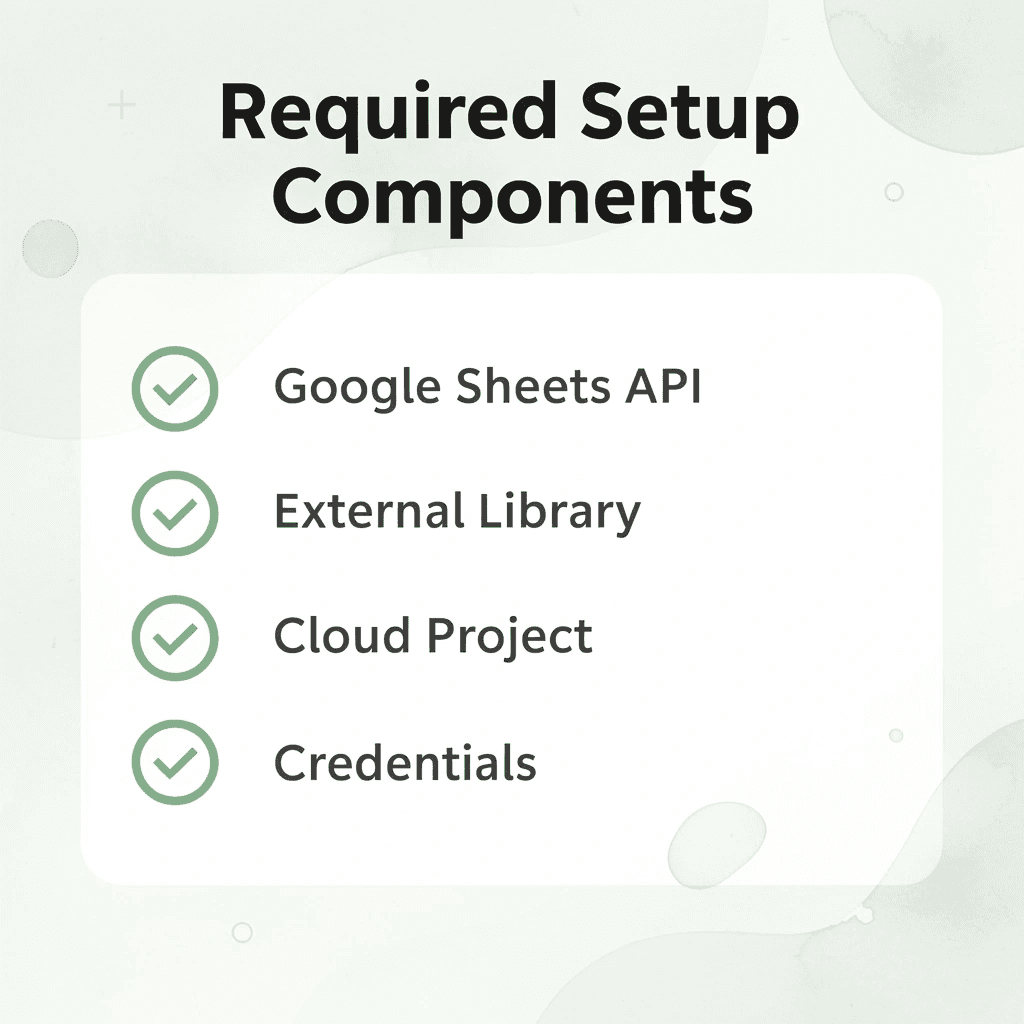
Google Sheets does not have a built-in Python environment. Every connection runs through the Google Sheets API, an external library, and a Google Cloud Platform project that you set up yourself.
"Every Python-to-Sheets connection requires three core components: the Google Sheets API, an external library, and a Google Cloud Platform project—none of which come pre-configured out of the box."
⚠️ Warning: Skipping the Google Cloud Platform setup is the most common mistake beginners make. Without it, your API calls will fail before you write a single line of Python.
💡 Tip: Before writing code, confirm you have all three components ready: the Google Sheets API enabled, your external library installed, and your GCP project configured.
Component | Purpose | Required? |
|---|---|---|
Google Sheets API | Connects Python to your spreadsheet | ✅ Yes |
External Library | Handles authentication & requests | ✅ Yes |
Google Cloud Platform Project | Manages credentials & permissions | ✅ Yes |
Confirm your actual use case first
The failure point is usually confusion about what the script needs to do. Reading a single column once a week and writing thousands of rows on a schedule are both "Python connected to Sheets," but they require different setup decisions, different permission scopes, and different error-handling considerations. Write down exactly what data moves, in which direction, and how often before opening a terminal. That specificity also determines whether you need the Google Drive API enabled alongside the Sheets API. If you're only reading public data, the permission surface shrinks considerably.
Choose your library with current maintenance status in mind
Check the GitHub page of any library you're considering. Look at the date of the last merged pull request and read the maintainer notes before writing code that depends on it. Using the most popular library without checking its repository status is how projects inherit problems they didn't create. Other options worth considering include pygsheets, ezsheets, and Google's own google-api-python-client. Each offers a different level of abstraction: pygsheets stays close to the Sheets API structure, while ezsheets trades control for simplicity. The right choice depends on how much flexibility your use case needs.
Set up your Google Cloud Platform project
Every Python-to-Sheets connection requires a Google Cloud project with the Sheets API enabled. Enable the Drive API at the same time to avoid returning to this step later. Google Developers' Python Quickstart estimates 10 minutes for Cloud Console steps if you're experienced. First-time users should allow more time: the console interface contains substantial information and assumes familiarity with OAuth concepts that most developers encounter here for the first time.
Generate credentials and share your spreadsheet
The step most people miss is sharing the spreadsheet with the service account. You can generate credentials, download the JSON file, and write working authentication code, but still receive a permission denied response if you haven't shared the spreadsheet with the service account's email address. That email looks like a generated string ending in iam.gserviceaccount.com. Share your target spreadsheet with it as you would with a colleague, using the appropriate editor or viewer permission, before running any script.
Install your library and test a minimal connection
Write the smallest possible script first: open the spreadsheet, read one cell, and print the value. If it fails, the problem lies in your credentials, sharing step, or API configuration, not your logic. This distinction saves significant debugging time.
Why should you isolate the connection test from your logic?
Most teams write the full script first and test everything at once. When something breaks, the error could be anywhere in authentication, permissions, library setup, or the script itself. Testing the connection separately from the logic is a faster way to find and fix problems.
How much setup does a complete working connection actually involve?
Analytics Vidhya's guide on using Python to automate Google Sheets has an 11-minute estimated reading time, reflecting the breadth of material covered in a complete working setup. The steps are straightforward individually, though more numerous than typical quick-start guides.
Consider whether Apps Script solves the problem more directly
For scheduled tasks, simple triggers, or custom menus, Google Apps Script runs natively inside Sheets with no Cloud Console setup, credentials file, or external library. It uses JavaScript rather than Python, but if your goal is automation rather than Python specifically, the setup overhead difference is significant. Ask whether the task requires Python's ecosystem (pandas, numpy, specific data pipelines) or automation. Mixing these up leads to over-engineered solutions when Apps Script would handle the problem cleanly.
Document your setup before you consider it done
Write down which library you chose, its version, your Google Cloud project name, and service account email. Save this information where the next person can find it in under a minute. An undocumented setup risks turning a future library change from an afternoon task into a week-long investigation.
What if you want to skip the setup chain entirely?
When the need is less about Python's technical depth and more about running intelligent, repeatable tasks directly inside a spreadsheet, teams increasingly turn to tools like Numerous, which eliminates the entire setup process. Instead of configuring Cloud projects and managing credentials, our spreadsheet AI tool lets users run AI-powered functions directly in Google Sheets and Excel through a simple formula interface, with no API keys, library choices, or authentication troubleshooting.
What changes when you follow these steps in order
Most people run into two problems: Google Cloud setup surprises them, and the sharing step trips them up after they think they're finished. Both are avoidable with the right approach and expectations. After working through these steps intentionally, you have a focused use case, an informed library choice, a tested connection, and documented setup. This is the same process tutorials describe, with the parts they quietly skip restored. The 20-minute estimate you keep seeing is real, but only under specific conditions that most guides fail to clarify.
Related Reading
How To Use Python In Excel
How To Connect Excel To LangChain
How To Compare Two Excel Sheets Using VLOOKUP
How To Combine Multiple Excel Sheets Into One
How To Add VBA To Excel
How To Build Agentic Workflows
Integrate Agent With Google Sheets
How To Delete Multiple Sheets In Excel
Best Python Tools For Excel
Data Visualization With Python In Excel
The 20-Minute Workflow to Connect Python to Google Sheets
The workflow below puts each step in order so you can check the result before moving forward. This way, if something fails at minute 12, you don't have to start over from the beginning wondering what went wrong.
"A structured, step-by-step workflow is the difference between a 20-minute setup and a 2-hour debugging session." — Developer Best Practices
💡 Tip: Follow each step sequentially and verify your output before advancing — this is the single most important habit that separates smooth integrations from frustrating ones.
⚠️ Warning: Skipping ahead without checking intermediate results is the most common mistake developers make when connecting Python to Google Sheets for the first time.
Step | What to Check | Time Estimate |
|---|---|---|
Authentication Setup | Credentials file is valid and accessible | ~5 minutes |
API Connection | Connection returns no errors | ~5 minutes |
Read/Write Test | Data appears correctly in your sheet | ~10 minutes |

Minute 0-5: Confirm Your Library Choice
Check gspread's current repository status before you write code. If your project needs long-term stability or your team will depend on it, this check matters. Using the most popular library without verification can create maintenance problems. The other libraries, pygsheets and google-api-python-client, aren't harder to use; they're just less common in tutorials. Spending five minutes on this choice prevents rework that might become a problem three months into your project.
Minutes 5-10: Create Your Google Cloud Project and Enable the APIs
Open Google Cloud Console, create a new project, and enable both the Google Sheets API and the Google Drive API. Enabling only one is a common source of authentication errors with unclear error messages. This authentication foundation is required for every subsequent step. Your Python script cannot connect to anything without it.
Minute 10-15: Generate Credentials and Share Your Spreadsheet
Create a service account inside your Google Cloud project, download the JSON credentials file, and copy the service account's email address. Then open your target Google Sheet and share it with that email address as you would with a coworker. The sharing step is often skipped because it feels separate from the "technical" setup, but it's not optional. Your script can authenticate successfully against Google's servers and still return a permission error if you never shared the spreadsheet with the service account.
Minute 15-18: Install Your Library and Run a Minimal Test
Install your chosen library with pip, then write the smallest script that does one thing: open your spreadsheet and read a single cell value. Not a loop, not a data transformation—just one cell.
Why does isolating the connection step matter?
This constraint keeps the connection separate from any logic you plan to build on top of it. If something is set up wrong, you discover it before spending time writing code that depends on a working connection. Most teams skip this step and jump straight into writing the full script. When a configuration problem surfaces in complex code, debugging becomes a search through many possible causes rather than one clear failure point.
What if you could skip the setup entirely?
Tools like Numerous take a different approach. Instead of requiring a Python environment, API credentials, and a cloud project, Numerous lets teams use a simple =AI() function directly in Google Sheets or Excel, with no setup required. For content teams, marketers, or researchers who need repeatable, intelligent tasks at scale inside a spreadsheet, our Spreadsheet AI Tool closes the gap between "I need this to work" and "I have a working connection."
Minute 18-20 Confirm the Result and Document Your Setup
When the test script returns the expected cell value, record three things: which library you chose, your Google Cloud project name, and the credentials file location. This two-minute step saves time whenever you return to the project or share it with others. According to a DEV Community walkthrough on connecting Python to the Google Sheets API, the full process takes about 20 minutes when you complete each step sequentially, with verification before moving forward. Without that structure, missed details at early steps don't surface until later, extending the timeline significantly.
Why the sequence matters more than the steps
The failure point in most Python-to-Sheets setups isn't a missing library or wrong API call, but trying the full setup at once without confirming each piece works first. Authentication, API access, spreadsheet permissions, and library installation are four separate systems that require individual verification.
What changes when you treat setup as sequential checkpoints?
When you treat the setup as one big block of work, a problem anywhere requires reviewing everything. When you treat it as four sequential steps, you can identify a problem at any step immediately. The improvement concerns organization, not technical details. What changes is how quickly you can determine if it's working.
Where does that realization leave you before moving forward?
That realization—that the complexity lay not in the code itself—opens a question worth considering before moving forward.
Skip the Setup Entirely for Everyday Tasks With Numerous
The complexity was never in the Python code—it was in recognizing which tasks need it. For data cleaning, summarizing, or repeatable automation inside a spreadsheet, a Google Cloud project and service account are infrastructure costs attached to tasks that don't require them.
"A Google Cloud project and service account are infrastructure costs attached to tasks that don't require them."
💡 Tip: Before spinning up cloud infrastructure, ask yourself: does this task genuinely need code-level control, or am I overengineering a simple job?
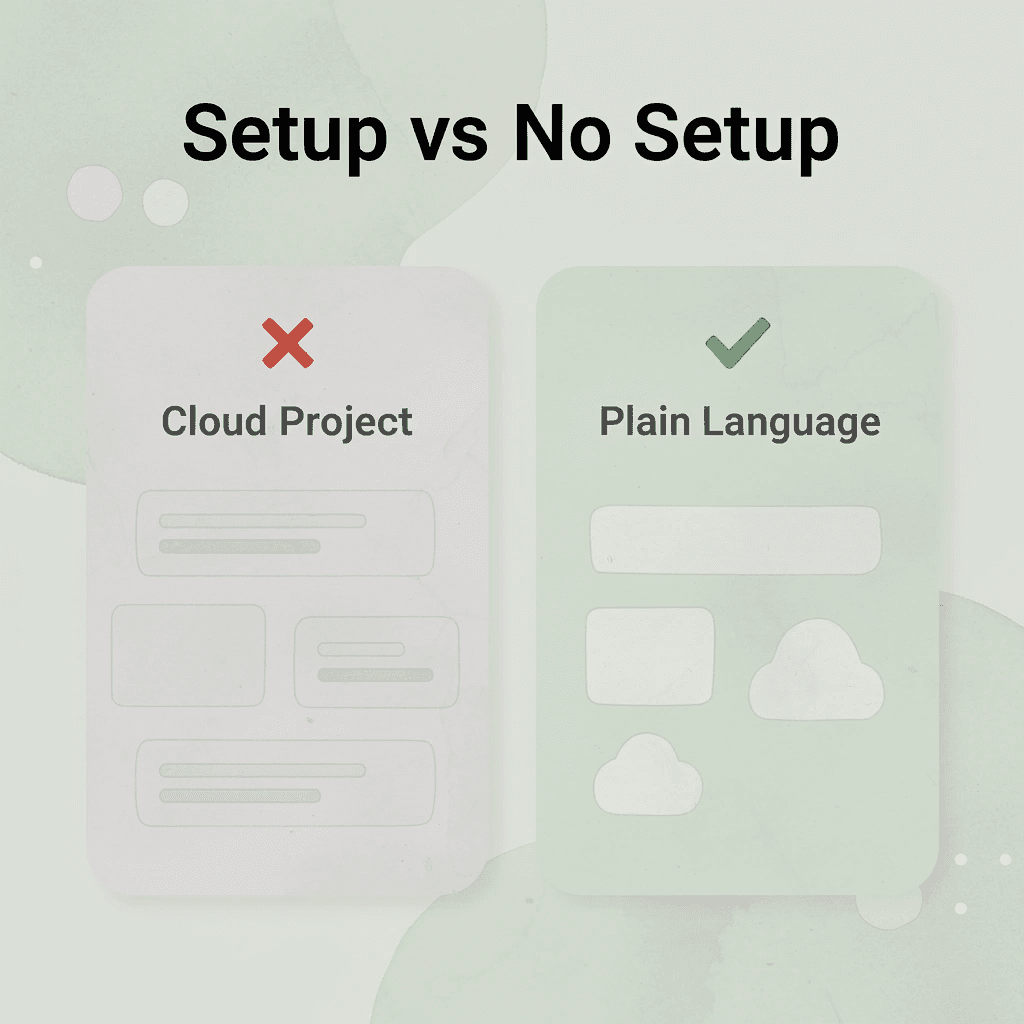
If your task fits that description, our Numerous 'Spreadsheet AI Tool' works directly inside Google Sheets with no setup. Open it in the sheet you're already using, describe what you need in plain language, and it does the work without credentials, library dependencies, or API configuration. Save Python for tasks that genuinely need code-level control, and use the simpler path for everything else.
Approach | Setup Required | Best For |
|---|---|---|
Python + Google Cloud | Service account, credentials, libraries | Complex, code-level automation |
None — works inside Google Sheets | Data cleaning, summarizing, repeatable tasks |
🎯 Key Point: Numerous eliminates every friction point—no credentials, no library dependencies, no API configuration—so you can go from idea to output in plain language.
⚠️ Warning: Defaulting to Python for every spreadsheet task adds unnecessary overhead. Match the tool to the job's complexity, not the other way around.
Related Reading
Datasnipper Alternatives
Lido Alternatives
Trullion Alternatives
Top Autonomous Agents For Web Research
Suralink Alternatives
Ai Agents For Multi-step Tasks With No Coding