Repetitive Excel tasks do not have to stay repetitive. VBA macros let users automate everything from formatting cells to generating reports with just a few lines of code, and practical examples make the learning curve far shorter than most expect. The seven VBA Excel examples covered here address real workflows, including looping through rows, building custom functions, and automating data summaries, all achievable within 20 minutes.
For those who want to move even faster, Numerous offers a Spreadsheet AI Tool that helps users generate, edit, and apply VBA code directly inside their spreadsheet, no programming background required.
Table of Contents
Why VBA Excel Examples Fail Even When the Code Is Correct
The Hidden Cost of Debugging Code That Was Never the Problem
7 VBA Excel Examples You Can Use in 20 Minutes
The 20-Minute Workflow to Get Any VBA Example Working Reliably
Skip the Troubleshooting for Everyday Tasks With Numerous
Summary
Repetitive Excel tasks that seem like code problems often have environmental causes. A "Mark of the Web" tag added when you download a workbook can silently block a perfectly valid macro from running, with no error message to indicate what went wrong. The fix takes about ten seconds once identified, but most users never reach it because the failure looks identical to broken code.
Version-specific software updates can break working macros without any official documentation. A Microsoft Q&A thread on VBA issues in Office 2024 confirmed that four consecutive Office builds from December 2025 through February 2026 produced VBA database connectivity failures, yet Microsoft 365 release notes for those builds noted zero known issues. Users experiencing real, reproducible failures had no official signal that the problem existed.
Debugging time is expensive, but misdirected debugging is a separate category of loss. Research from Sonar found that 80% of debugging time is spent finding the bug rather than fixing it. When the environment is the real cause, that entire 80% is spent in the wrong place because the bug being searched for doesn't exist in the code at all.
A single missing keyword accounts for a large share of VBA failures on modern machines. Any Win32 API declaration written before Microsoft 365 became the 64-bit default in 2019 will produce an immediate compile error unless the PtrSafe keyword is added to each declaration. The error message points to the declaration line but gives no indication that adding one keyword resolves it completely.
Environmental checks in the right order consistently outperform code-first debugging. Confirming file trust status, checking 64-bit API compatibility, and verifying library references in the Tools menu each take under two minutes. According to ITU Online IT Training, a structured VBA automation workflow read-through takes around twenty minutes, and applying that same time to a sequenced environmental checklist produces a reusable diagnostic reference rather than a one-time fix.
The habits built around running VBA examples correctly compound over time. Excel is used in almost every workplace, making it one of the most commonly used pieces of software according to note.com's Excel Macro Use Cases, which means diagnostic patterns that save one developer two hours per month scale across every team member working in the same files.
Numerous' Spreadsheet AI Tool addresses this by letting teams run AI-driven automation directly in Excel without VBA dependencies, removing file-trust barriers, library-reference checks, and bitness conflicts that cause silent macro failures before any code runs.
Why VBA Excel Examples Fail Even When the Code Is Correct
Most VBA Excel examples online have correct logic and valid syntax, but still fail because of environment mismatches rather than code errors. This is one of the most frustrating traps in Excel development — your code isn't broken, your environment is.
"The majority of VBA failures aren't caused by bad code — they're caused by environment-level blocks that silently prevent execution before a single line runs."
⚠️ Warning: Don't waste hours debugging correct code. If your macro fails silently with no error message, the problem is almost certainly environmental, not logical.
Failure Type | Cause | Fix Required |
|---|---|---|
Silent macro failure | Environment mismatch | Check security settings |
Syntax error | Code logic issue | Debug the script |
Blocked execution | Mark of the Web tag | Unblock the file |
Trust Center block | Macro settings disabled | Enable macros in settings |

The main problem is file-download tagging. Windows adds a "Mark of the Web" tag to downloaded files, which causes Excel to block macro execution by default — even for perfectly written code. The fix is simple: right-click the file, open Properties, and check Unblock at the bottom. Most people never find this solution because the macro's silent failure looks identical to broken code, making it nearly impossible to diagnose without knowing where to look.
💡 Tip: Before debugging a single line of VBA, right-click your downloaded file → Properties → Unblock. This one step resolves most mysterious macro failures.
🔑 Takeaway: A silent macro failure is your biggest clue — real code errors throw error messages. If nothing happens, the issue is Windows security tagging, not your VBA logic.
When the environment fights back silently
Enterprise security tools add a second, less visible layer. According to a Microsoft Q&A thread on VBA problems in Office 2024, four consecutive Office builds from December 2025 through February 2026 produced VBA database connectivity failures, with only the November 2025 build working correctly. A macro that ran without issue last quarter can fail this quarter without code changes. CrowdStrike, Defender for Endpoint, and SentinelOne can halt macro execution with no visible error message in Excel, leaving users with a spreadsheet that simply stopped.
Why does the 64-bit syntax gap cause so many silent failures?
The 64-bit syntax gap creates a third category of failure when reusing older VBA examples. Any code containing Win32 API declarations written before 2019 will produce a compile error on a modern 64-bit installation unless the PtrSafe keyword is added to each declaration. The error message points at the declaration line but doesn't indicate that a single keyword fixes it. The code's logic is sound; the declaration format is outdated for the current runtime.
What is the hidden cost of treating every macro failure as a code problem?
Most teams treat every major failure as a code problem and work backward through the logic. The hidden cost is time spent checking correct code while the actual blocker—file tagging, a security tool, a version mismatch, or a missing library reference—remains unaddressed. Tools like Numerous's Spreadsheet AI Tool change this approach: instead of starting from a raw example and debugging through environmental friction, you can generate, edit, and test VBA directly inside your spreadsheet with AI assistance that accounts for your current context.
Microsoft Q&A's accepted answer on the same VBA thread confirms that Microsoft 365 release notes for the affected builds documented zero official known issues related to VBA database connectivity failures. Users experiencing reproducible failures had no official signal that the problem existed, reinforcing why silent failures get misread as user error rather than environment-level blockers. The code was never the problem. The environment just never said so.
Related Reading
How To View Hidden Sheets In Excel
Vba Excel Examples
Python In Google Sheets
Google Sheets VBA
How To Connect Google Sheets To Crewai
How To Connect Google Sheets To Langchain
Can You Group Sheets In Excel
The Hidden Cost of Debugging Code That Was Never the Problem
Debugging time is expensive, but misdirected debugging is a different category of loss entirely. According to Sonar's research on the true cost of bad code, 80% of debugging time is spent finding the bug, not fixing it. When the environment is the actual cause, that 80% gets spent searching for a bug that doesn't exist in the code at all.
"80% of debugging time is spent finding the bug, not fixing it. When the environment is the real culprit, that time is spent chasing a problem that was never in the code to begin with." — Sonar Research
⚠️ Warning: A misconfigured environment makes every debugging minute wasted effort — you're solving the wrong problem entirely.
🔑 Takeaway: The real cost isn't just developer hours — it's the compounding loss of time spent hunting a bug that doesn't exist, while the actual root cause goes undetected and unfixed.

Why does a working macro suddenly look like a broken one?
The failure point is usually invisible. A VBA macro that runs perfectly on one machine and silently fails on another may look like a code problem, prompting developers to open the VBA editor and investigate: questioning module structure, reviewing variable declarations, rewriting loop logic. None of that addresses the actual cause: a missing library reference in the Tools menu or a 32-bit API call requiring one keyword for modern Office installations.
What misdiagnosis actually costs
A macro that fails because of a missing reference in the VBA editor's Tools, References menu can be fixed in under two minutes once you correctly identify it. The same failure, misread as a logic error, can consume an afternoon. Checking the reference list, confirming Office bitness, and verifying file trust status takes less time than reading through fifty lines of code looking for a syntax error that doesn't exist.
Why does starting with the code make the problem harder to find?
Most people start with the code first, since it's the visible and familiar starting point. But when the failure is environmental, this produces nothing except a growing sense that something subtle hides deeper in the logic. Teams using Numerous sidestep this entirely: by running AI-driven automation directly inside Excel without VBA dependencies, environment-level failure modes that cause silent macro interruptions simply don't apply. No library references to check, no bitness conflicts, no file trust barriers to clear before a workflow runs.
Why was the original example right all along?
The pattern that shows up most consistently across VBA troubleshooting is this: the original example was correct. The 64-bit compatibility issue documented in current guidance doesn't mean older VBA resources are unreliable. It means one specific, known change in the default Office environment since 2019 requires one specific, known update to any Win32 API declaration. According to CloudQA's 2025 report on software bug costs, 85% of defects are introduced during the design phase, yet most debugging time is spent during coding. That same mismatch plays out in VBA troubleshooting: the environment is where the problem was introduced, but the code is where all the time gets spent.
What does treating correct code as broken actually cost?
When you treat correct code as broken, people lose confidence in VBA examples. The next time someone finds a well-made example that could help them, they'll be suspicious instead of curious. Once you see what a working macro can do in twenty minutes, you realize that the cost isn't worth it.
Related Reading
How To Use Python In Excel
How To Connect Excel To LangChain
How To Compare Two Excel Sheets Using VLOOKUP
How To Combine Multiple Excel Sheets Into One
How To Add VBA To Excel
How To Build Agentic Workflows
Integrate Agent With Google Sheets
How To Delete Multiple Sheets In Excel
Best Python Tools For Excel
Data Visualization With Python In Excel
7 VBA Excel Examples You Can Use in 20 Minutes
Each example below pairs working code with the environment check that prevents failure.
"The difference between VBA code that works once and code that works every time is the environment check built around it." — VBA Best Practices
💡 Tip: Before running any of the 7 examples below, make sure your Developer Tab is enabled in Excel — this is the single most common blocker for beginners.
⚠️ Warning: Skipping the environment check paired with each code block is the fastest way to introduce silent errors that are difficult to debug later.
Example Type | What It Does | Time to Implement |
|---|---|---|
Loop Through Rows | Iterates over every row in a dataset | ~3 minutes |
Auto-Format Cells | Applies consistent styling automatically | ~2 minutes |
Error Handling Block | Prevents crashes on bad input | ~4 minutes |
Find & Replace Macro | Replaces values across the entire sheet | ~2 minutes |
Dynamic Range Selector | Detects the last used row automatically | ~3 minutes |
Worksheet Event Trigger | Fires code on change without manual runs | ~4 minutes |
Export to PDF | Saves the active sheet as a PDF instantly | ~2 minutes |

1. Highlight Duplicate Values in a Range
Manually scanning a column for duplicates is slow and unreliable past a few hundred rows. This macro applies Excel's built-in conditional formatting logic through VBA, so it flags duplicates instantly across any selection size.
```
Sub HighlightDuplicates()
Dim rng As Range
Set rng = Selection
rng.FormatConditions.AddUniqueValues
rng.FormatConditions(rng.FormatConditions.Count).DupeUnique = xlDuplicate
rng.FormatConditions(rng.FormatConditions.Count).Interior.Color = RGB(255, 199, 206)
End Sub
```
Environment check: this uses only built-in Excel objects with no external references or API declarations, so it runs without additional setup on any modern Excel version once macros are enabled.
2. Auto-Fit All Columns in the Active Sheet
After importing data, column widths are almost always wrong. Fixing them manually is the kind of small friction that compounds into real time loss across a workday.
```
Sub AutoFitAllColumns()
ActiveSheet.Columns.AutoFit
End Sub
```
Environment check: this is the simplest VBA operation possible, with zero dependencies. If this macro fails to run, the cause is almost certainly file blocking or macro security settings, not the code.
3. Save the Active Workbook With a Timestamp in the Filename
Manual version tracking through renamed files breaks the moment someone forgets a step. This macro builds the timestamp directly into the filename on every save, removing that failure point entirely.
```
Sub SaveWithTimestamp()
Dim ts As String
ts = Format(Now, "yyyy-mm-dd_hhmm")
ActiveWorkbook.SaveAs ThisWorkbook.Path & "\" & "Report_" & ts & ".xlsx"
End Sub
```
Environment check: confirm the workbook has been saved at least once before running this. If `ThisWorkbook.Path` is blank (meaning the file has never been saved), the SaveAs path will be incomplete and the macro will error.
4. Loop Through a Range and Flag Values Above a Threshold
Reviewing a column for values above a specific limit doesn't scale past a small dataset when done manually. This macro loops through your selection and highlights anything above the threshold you set, without touching values below it.
```
Sub FlagAboveThreshold()
Dim cell As Range
Dim threshold As Double
threshold = 1000
For Each cell In Selection
If IsNumeric(cell.Value) And cell.Value > threshold Then
cell.Interior.Color = RGB(255, 235, 156)
End If
Next cell
End Sub
```
Environment check: this loops through only the cells you have already selected. Confirm your selection before running it. The macro does not prompt you to choose a range. Most teams handle this kind of threshold review by sorting columns manually and eyeballing the cutoff. That works for twenty rows. At two hundred rows, it introduces errors. At two thousand, it stops being a viable method entirely. Tools like Numerous let teams run AI-driven classification and flagging logic directly in Excel without writing any VBA, which matters when the threshold logic changes often or multiple people need to run the same check on different datasets.
5. Export the Active Sheet as a PDF
Navigating File, Export, Create PDF every time you need to send a recurring report is the kind of repetitive task that feels minor until you count how many times you do it in a month.
```
Sub ExportActiveSheetToPDF()
ActiveSheet.ExportAsFixedFormat Type:=xlTypePDF, _
Filename:=ThisWorkbook.Path & "\" & ActiveSheet.Name & ".pdf", _
Quality:=xlQualityStandard
End Sub
```
Environment check: confirm your active sheet's paper size, orientation, and scaling are set as intended before running this. The macro exports exactly what your current page setup specifies, nothing more and nothing less.
6. Remove Blank Rows From a Selected Range
Scattered blank rows in a large dataset are tedious to delete manually and easy to miss. This macro loops backward through your selection specifically to avoid the row-skipping bug that appears in versions of this macro that loop forward.
```
Sub RemoveBlankRows()
Dim i As Long
For i = Selection.Rows.Count To 1 Step -1
If Application.WorksheetFunction.CountA(Selection.Rows(i)) = 0 Then
Selection.Rows(i).EntireRow.Delete
End If
Next i
End Sub
```
Environment check: select the range you want to clean before running this. The backward loop is intentional and correct. If you find a version of this macro online that loops forward, that version has a known bug where rows get skipped after each deletion.
7. Send an Email From Excel Using Outlook
Manually composing the same recurring report email is repetitive and adds no value. This macro creates and sends the email directly from Excel and attaches the current workbook.
```
Sub SendEmailFromExcel()
Dim OutApp As Object
Dim OutMail As Object
Set OutApp = CreateObject("Outlook.Application")
Set OutMail = OutApp.CreateItem(0)
With OutMail
.To = "[email protected]"
.Subject = "Weekly Report"
.Body = "Please find the attached report."
.Attachments.Add ThisWorkbook.FullName
.Send
End With
End Sub
```
Environment check: this requires Outlook to be installed and configured on the same machine. It will not work with a web-only Outlook account. The first run may trigger a security prompt asking you to confirm the automated send.
What changes when you run these correctly
According to note.com's Excel Macro Use Cases, learning macros can speed up your work by automating repetitive tasks. The environment check bridges the gap between an example that works and a result that works in your specific file on your specific computer.
How does confirming the environment check change your results?
The difference between before and after is running each example with its environment check confirmed first. Any failure points to a specific, fixable cause instead of triggering a debugging session at the wrong layer. note.com's Excel Macro Use Cases notes that Excel is used in almost every workplace, making the habits you build around running VBA examples correctly compound across every team member who touches the same files. Seven examples, each with a paired check, each runnable in under twenty minutes: that's what these macros can do for you. But knowing a macro works differs from knowing it will work reliably every time you need it.
The 20-Minute Workflow to Get Any VBA Example Working Reliably
You get consistent results from VBA macros by checking the right things in the right order, before you start working with the code. The workflow below works for any Excel macro example you find — whether it came from a forum, a file a colleague shared, or a tutorial.
"The difference between a macro that works every time and one that fails unpredictably comes down to a disciplined pre-flight checklist — not luck, not experience alone."
💡 Tip: Before running any VBA example you didn't write yourself, treat it as untrusted code — verify the source, the scope, and the dependencies first.
⚠️ Warning: Skipping the setup verification step is the single most common reason developers waste 20+ minutes debugging errors that were never about the code itself.
Where the Example Came From | Key Thing to Verify First |
|---|---|
Online forum or tutorial | Module type and macro scope |
Colleague's shared file | References and dependencies |
Your own archive | Excel version compatibility |
🎯 Key Point: The 20-minute workflow is built around eliminating variables — so that when something goes wrong, you know exactly where to look and can fix it fast.
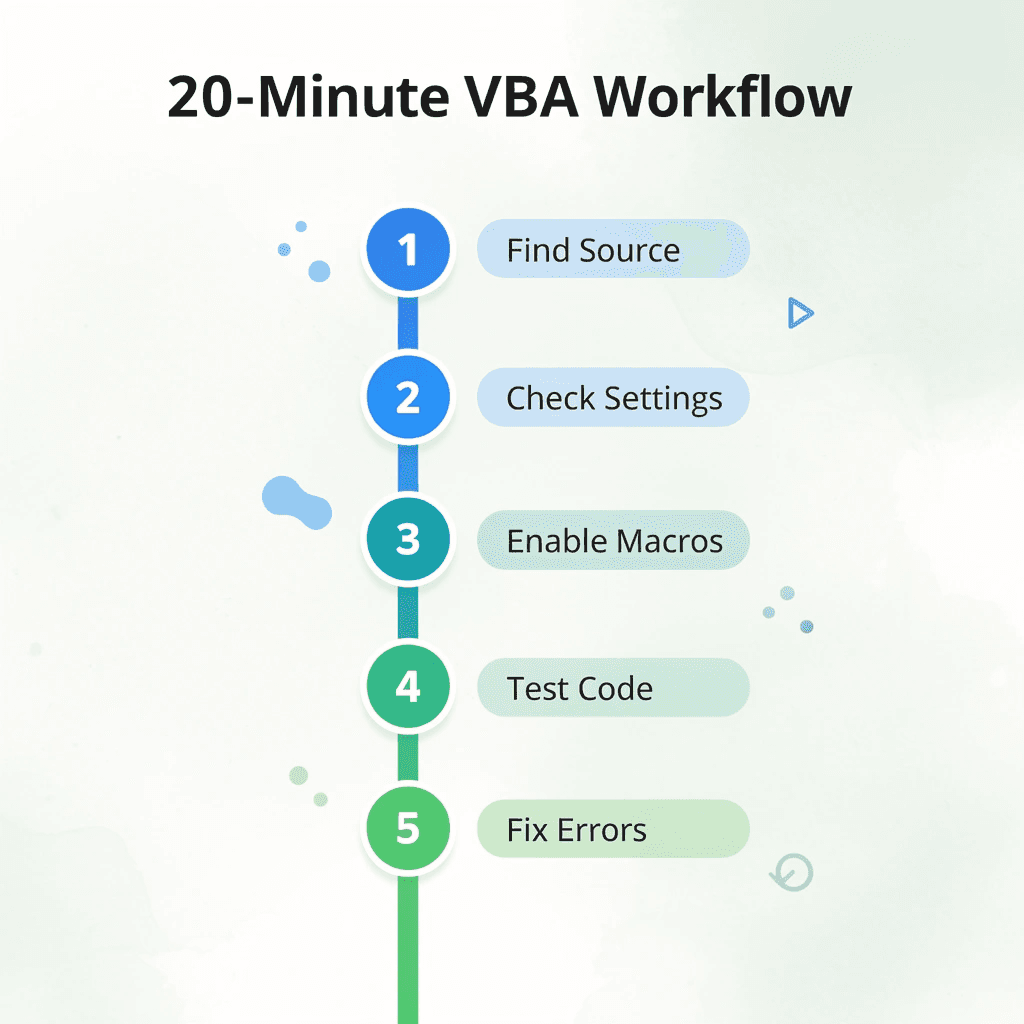
Minute 0-5: Confirm the File's Source and Trust Status
If the code came from a downloaded file, check its Properties for an Unblock option, or add its folder to Excel's Trusted Locations before running any macro. File-level blocks are the most common documented cause of correct macros failing to run. The failure point is invisible: nothing in the VBA editor shows the file is blocked. The code looks fine, you run it, nothing happens. Checking trust status first eliminates this category of false alarms before they consume your time.
Minutes 5-10: Check for Win32 API Declarations
Look for any line starting with Declare Function or Declare Sub, then verify the PtrSafe keyword is present if you're using 64-bit Office. This distinguishes older 32-bit examples from the 64-bit Office environment standard since 2019. This problem appears in beginner tutorials and advanced automation scripts alike: an example written five years ago works fine on some computers and crashes on others. The difference is almost always about whether it's 32-bit or 64-bit, not about the logic itself.
Minutes 10-15: Verify Required References
Open the VBA editor's Tools menu, select References, and confirm any library the example mentions is checked. Microsoft Scripting Runtime is the most common culprit: unchecked external library dependencies produce compile errors with no indication that a simple checkbox resolves the issue. Most people search line by line for a typo that isn't there. The error message points at the object, not the missing reference. Checking References first turns a confusing fifteen-minute search into a thirty-second confirmation.
Minutes 15-18: Run the Macro and Watch the Execution
Run the macro and watch whether it completes fully or stops partway through with no error message. A silent mid-run stop is the documented signature of security-tool intervention, not a code problem. Recognizing that pattern means checking with IT rather than rewriting the logic.
Why does a silent stop mean the environment is wrong, not the code?
This difference matters because rewriting working code because a security tool stops you is one of the more expensive mistakes a developer can make quietly. The code was never broken; the environment was the variable.
Most teams debug from the code outward, checking syntax, variable types, and logic before questioning the environment. That instinct makes sense—but it's why a two-minute environmental fix regularly costs two hours. As macros interact with more external libraries, security policies, and shared network paths, the gap between "the code is wrong" and "the environment is wrong" becomes the most expensive assumption in the workflow.
Can shared spreadsheet tools remove these environmental dependencies entirely?
Teams running shared Excel files across departments often find that a tool like Numerous sidesteps this friction. Instead of distributing macro-enabled workbooks that require individual trust settings, reference checks, and bitness verification, AI functions run directly inside the spreadsheet without environmental dependencies, making it a practical alternative for repetitive tasks.
Minutes 18-20: Document Which Checks Applied
Note which checks were relevant for this example. This transforms a one-time troubleshooting pass into a growing personal reference specific to your environment and macro types. According to ITU Online IT Training's guide on VBA automation projects, a structured VBA workflow takes around twenty minutes. Applied to this checklist, that time produces a documented map of which environmental factors affect your setup, enabling you to evaluate future examples faster and more accurately.
Why the Order Matters
The sequence is deliberate. File trust status comes first because it's the most common cause and the easiest to miss. API declarations come second because their errors resemble code problems. References come third because their compile errors are misleading. Execution behavior comes last because you must resolve the first three before a clean run yields meaningful information. Skipping to code-level debugging without this sequence is like checking a car's engine before confirming it has fuel.
Before and After What Actually Changes
The critical difference is knowing which layer to check first. But the troubleshooting sequence only solves part of the problem: the part most people never question.
What happens before and after applying this workflow?
Before this workflow, a failed macro triggers immediate code inspection. The developer looks for syntax errors, checks variable declarations, and questions the logic, while file trust status, API declaration syntax, and missing references go unchecked. Hours pass. The code was fine all along. After this workflow, the same developer spends five minutes on environmental checks and identifies the actual cause. The code runs. Documentation from that session speeds up the next evaluation, and this improvement compounds across every new VBA example they encounter.
Skip the Troubleshooting for Everyday Tasks With Numerous
A simpler question often goes unasked: does this task need a macro? For common spreadsheet jobs—flagging duplicates, cleaning up inconsistent text, or categorizing datasets—the answer is frequently no. Reaching for VBA by default introduces file trust checks, security software conflicts, and syntax version issues to tasks that never required that overhead.
"For common spreadsheet jobs like flagging duplicates, cleaning text, and categorizing datasets, the overhead of VBA is rarely the right match for the task at hand."
⚠️ Warning: Defaulting to VBA macros for every spreadsheet task introduces unnecessary complexity: trust settings, security prompts, and version conflicts that add friction without adding value.
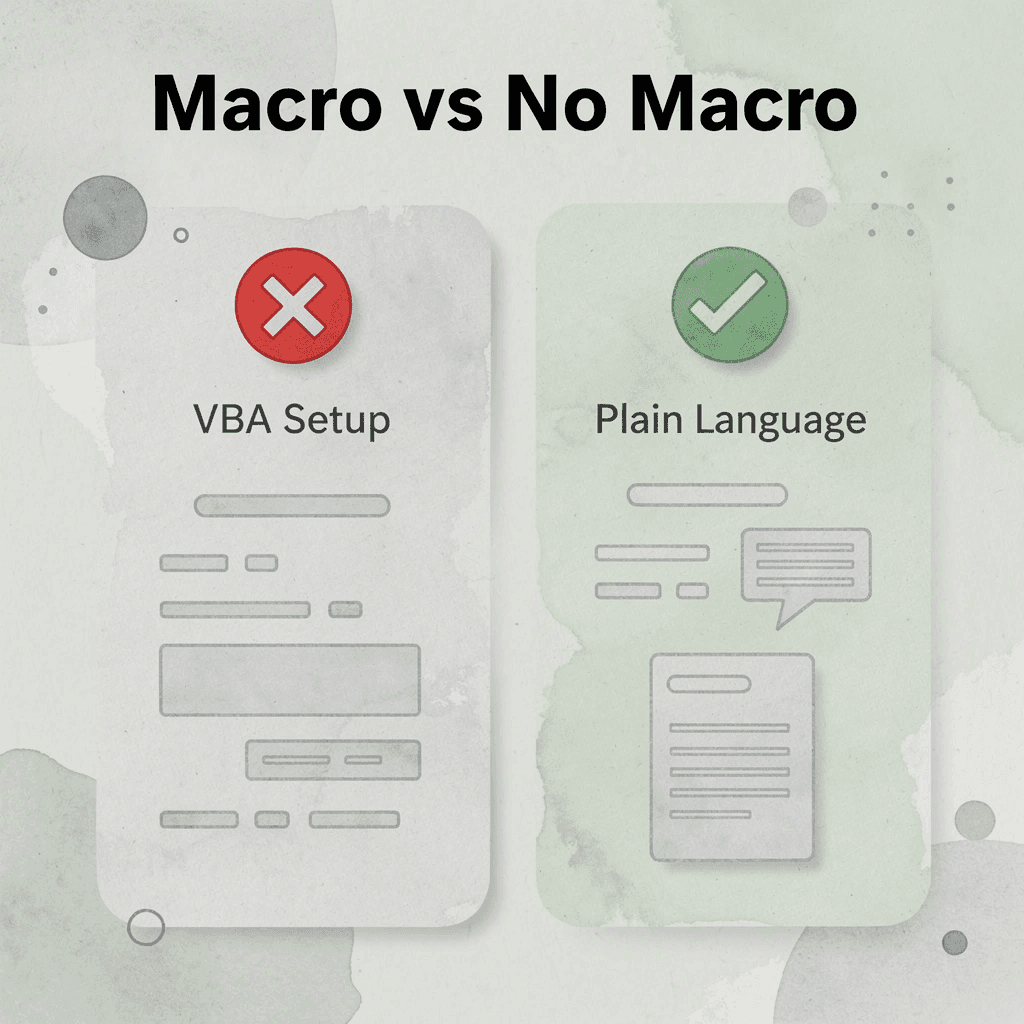
💡 Tip: If you can describe what you need in plain language, Numerous can likely handle it — no VBA editor, no Trust Center settings, no macro security prompts required.
Numerous addresses this gap directly. Teams open the Numerous Spreadsheet AI Tool directly in their sheet, describe what they need in plain language, and get results without touching the VBA editor, Trust Center settings, or macro security prompts. For tasks requiring genuine automation logic, the earlier workflow and examples still apply. For everything else, skipping the setup entirely isn't a shortcut — it's the right match between tool and task.
Task Type | Best Tool |
|---|---|
Flagging duplicates | Numerous AI |
Cleaning inconsistent text | Numerous AI |
Categorizing datasets | Numerous AI |
Complex automation logic | VBA Macros |
🎯 Key Point: Numerous isn't just a convenience — it's the correct tool for the majority of everyday spreadsheet tasks, eliminating setup overhead and letting teams focus on results, not configuration.
Related Reading
Suralink Alternatives
Trullion Alternatives
Lido Alternatives
Datasnipper Alternatives
Ai Agents For Multi-step Tasks With No Coding
Top Autonomous Agents For Web Research