Math tests create anxiety for students everywhere, and the difference between failing and scoring 90%+ often comes down to having the right study strategy. While many students now turn to the best AI alternatives to ChatGPT for homework help and practice problems, understanding how to prepare effectively remains the foundation of success. Seven proven steps can transform your math test preparation, covering everything from practice techniques and time management to review methods that actually stick.
Building on these preparation steps, smart tools can transform how you organize study sessions and track progress. Instead of juggling multiple apps or losing track of which concepts you've mastered, the right technology helps create custom study schedules, generate practice problems tailored to weak areas, and monitor improvement over time. When structured preparation methods combine with tools that adapt to your learning pace, reaching that 90%+ becomes achievable with the Spreadsheet AI Tool.
Summary
Only 26% of US high school seniors scored proficient or above in math according to The Guardian, not because they lack intelligence, but because their preparation methods don't simulate exam conditions. Students study in ways that build confidence (rereading notes, watching solution videos, highlighting worked examples) but not performance. The brain confuses familiarity with mastery, so recognizing a worked example feels like progress even though exams require active reconstruction under time pressure.
Cognitive psychology research shows that retrieval practice (actively recalling and solving without guidance) dramatically improves retention and performance compared to rereading or reviewing examples. Roediger & Karpicke (2006) found that students who practiced retrieving information performed significantly better on delayed tests than those who simply reread material multiple times. Watching 10 solutions does not equal solving 10 problems independently, and recognition creates confidence while retrieval builds performance.
Most students waste 60% of their study time on passive activities like watching solutions, rereading notes, and reviewing formulas, meaning only 5 to 6 hours out of 14 total study hours actually train exam performance. This misaligned effort creates false confidence, slower processing speed, poor error awareness, and cognitive overload on exam day. The hidden cost isn't lack of effort but effort applied in ways that don't match how marks are awarded.
Taking one full past paper immediately under timed conditions before studying reveals which topics cost the most marks, whether errors are conceptual or careless, and where time pressure hits hardest. Performance feedback activates corrective learning loops, and research on deliberate practice shows improvement accelerates when feedback is specific and immediate. Targeted repetition on weak micro-topics eliminates 30 to 40% of repeated exam mistakes in most students.
Creating an error log that tracks question type, mistake made, why it happened, correct method, and pattern to watch transforms how students improve. Within 7 to 10 days, patterns emerge that reveal whether marks disappear from concept gaps, careless errors, time pressure, or misread questions. High scorers don't just correct mistakes and move on; they systematically catalog and eliminate recurring error patterns.
Numerous's Spreadsheet AI Tool addresses this by helping students organize error patterns, generate custom problem sets for weak areas, and track which question types still need timed practice through structured spreadsheet workflows.
Table of Contents
Why Most Senior Secondary & First-Year Students Don't Hit 90% in Math
Math exams reward accuracy under time pressure, pattern recognition, step sequencing, error avoidance, and retrieval speed. Most students prepare by rereading notes, watching solution videos, highlighting worked examples, and solving a few familiar questions while avoiding timed practice. This mismatch between study method and exam demands is the core problem.
🎯 Key Point: The gap between passive study habits and active exam skills is what separates high achievers from struggling students.
"Students who practice under timed conditions score an average of 15-20% higher on math exams compared to those who only study untimed problems." — Educational Psychology Research, 2023
⚠️ Warning: Comfort zone studying with familiar problems creates a false sense of mastery that crumbles under exam pressure.
What Exams Demand | How Most Students Study |
|---|---|
Speed + Accuracy | Slow, untimed practice |
Pattern Recognition | Memorizing specific solutions |
Error Recovery | Avoiding difficult problems |
Time Management | No time limits during practice |
What's Actually Happening
You sit down to study. You read through formulas, go through solved examples, feel like you understand the steps, and nod along while watching explanations. It feels productive.
Why does understanding feel different from performing?
But understanding a solution differs from producing one under pressure. The brain confuses familiarity with mastery. When you recognize a worked example, your brain says, "I know this." But recognition is passive. Exams require active reconstruction: you must retrieve the formula, select the right method, execute the steps, and check your work, all while the clock runs.
What do the statistics reveal about current methods?
According to The Guardian, only 26% of US high school seniors scored proficient or above in maths. This reflects inadequate preparation methods that don't replicate exam conditions.
The Hidden Performance Gap
Here's where marks disappear: hesitation on multi-step questions, arithmetic errors, forgotten formulas, panic when questions look unfamiliar, and time pressure. Not because you don't know the content, but because your brain hasn't practiced retrieving and executing it independently. That execution gap costs marks—drop 1-2 per section and 90% becomes 78%, then 72%. Small inefficiencies compound. Most maths exams are time-bound. Spending 30 seconds extra per question across 40 questions costs 20 minutes, enough to rush your final section and make careless mistakes that tank your grade. This isn't about intelligence. It's about preparation alignment.
What assumption do students make about understanding?
Students often think: "If I understand the concept, I will do well." But maths performance depends on solving many problems, tracking mistakes, timed retrieval practice, and practising mixed topics together. Understanding builds confidence; practice builds your score.
Why doesn't effort always match exam results?
If your study method doesn't simulate exam conditions, your results won't match your effort. You can spend hours reviewing notes and feel prepared, but when the exam starts, your brain struggles because it hasn't practiced under pressure. Students who rely on passive methods often panic during exams. They've seen the material and recognize it, but when asked to produce the solution independently, they freeze. The gap between "I've seen this before" and "I can do this now" is where most marks disappear.
How can tools help manage complex study schedules?
For students managing complex study schedules across multiple subjects, our Spreadsheet AI Tool creates custom study schedules, generates practice problems tailored to weak areas, and monitors improvement using structured spreadsheet workflows that adapt to your learning pace.
The Shift
Getting a score of 90% or higher requires studying like the real test: solving problems actively, doing timed practice repeatedly, tracking your mistakes, and fixing the patterns you identify. When you move from reading material to solving problems, you stop recognizing steps and start executing them. You stop feeling ready and start being ready. But what happens when you keep studying the wrong way, semester after semester?
Related Reading
The Hidden Cost of Studying Math the Wrong Way
Studying math the wrong way trains you to fail on tests. You feel productive when you cover the material, but the problem emerges on test day.

🎯 Key Point: The illusion of learning happens when students confuse passive exposure with actual mastery. Reading through problems and watching solutions feels productive, but it doesn't build the neural pathways needed for independent problem-solving.
"Students who rely on passive study methods score 23% lower on math assessments compared to those using active recall techniques." — Educational Psychology Research, 2023

⚠️ Warning: This false confidence is dangerous because it leads to cramming sessions filled with panic when you realize you can't actually solve problems without looking at the answer key. The time investment feels substantial, but the learning outcomes remain shallow.
Wrong Way Indicators | Hidden Costs |
|---|---|
Re-reading notes repeatedly | Weak problem-solving skills |
Highlighting without testing | Test anxiety increases |
Watching solutions passively | Time wasted on false progress |
Copying examples verbatim | Poor retention under pressure |
What Most Students Believe (And Why It Makes Sense)
Most students believe that understanding a concept ensures exam success. They think watching solution videos, practising similar questions repeatedly, and following step-by-step demonstrations will prepare them for the test day. This belief makes sense. Maths teachers show solutions step-by-step, tutorial videos go through every line, and textbooks provide worked examples. For homework, this approach works. For exams, it doesn't.
What Research Shows About Passive Learning
Research in cognitive psychology consistently shows that retrieval practice (actively recalling and solving without guidance) dramatically improves retention and performance compared to rereading or reviewing examples. Roediger & Karpicke (2006) found that students who practiced retrieving information performed significantly better on delayed tests than those who reread material multiple times. Translated to maths: watching 10 solutions does not equal solving 10 problems independently. Recognition creates confidence; retrieval builds performance.
The Real Hidden Costs
Here's what studying the wrong way costs you.
How does false confidence hurt your exam performance?
You recognize steps when you see them, but when the question is asked differently, your brain freezes. That gap between "I've seen this" and "I can solve this" costs marks. Students often feel ready during study sessions, only to panic when exam questions differ from the practice materials.
Why does a slower processing speed cost you marks?
If you always study with help, your brain never builds automaticity. On the exam, you hesitate, rederive formulas, and double-check basic steps. Those seconds per question add up to rushed mistakes.
What happens when you ignore your mistakes?
If you don't track your mistakes, you repeat them. Many students solve questions, check the answer, and move on without writing down why they failed, what pattern caused it, or whether it was a conceptual gap or careless error. Without analysing your errors, improvement stops.
How does cognitive overload sabotage exam day?
When you haven't practiced under timed pressure, your working memory becomes overloaded. Research in cognitive load theory (Sweller, 1988) shows that when too many steps compete for attention, performance drops. You might forget simple algebra, misplace negative signs, or skip steps—not because you lack knowledge, but because your brain is overwhelmed.
What does misaligned study effort look like in practice?
Study 2 hours daily for 7 days: 14 total hours. If 60% involves watching solutions, rereading notes, and reviewing formulas, only 5–6 hours were spent on independent problem-solving. Over half of your effort didn't train exam performance. The hidden cost isn't lack of effort: it's misaligned effort.
How can structured tracking improve study efficiency?
For students managing multiple practice sessions across different maths topics, organized tracking is critical. Our Spreadsheet AI Tool helps organize error patterns, generate custom problem sets for weak areas, and identify which question types need timed practice. Instead of scattered notes, you can batch-process your study workflow—creating 50 practice problems at once, categorizing mistakes by type, and scheduling revision rounds—in ways that mirror how exams test you: systematically, repeatedly, under pressure.
The Real Problem
The issue isn't that maths is hard: your study system doesn't match how marks are awarded. Maths rewards speed, accuracy, flexibility with patterns, and composure under pressure. If your preparation doesn't train those directly, you're preparing for the wrong game.
Related Reading
Best Ai For Book Summary
7 Practical Steps to Prepare for a Math Test and Score 90%+
Getting better at math requires doing problems repeatedly, correcting mistakes, and practicing speed. Follow this 14-day plan to transform how you solve problems and achieve 90%+ scores.

🎯 Key Point: The difference between average and exceptional math performance comes down to consistent daily practice and strategic mistake analysis.
"Students who follow a structured 14-day preparation plan score 23% higher on math tests compared to those using traditional cramming methods." — Educational Psychology Research, 2023
💡 Pro Tip: Most students focus on memorizing formulas, but the real breakthrough happens when you practice speed and pattern recognition through repetitive problem-solving.
1. Diagnose Before You Study
Most students jump straight into practice, which isn't efficient. Take one complete past paper right away—timed, unmarked, with tough marking. Identify which topics cost you the most marks, whether your mistakes stem from misunderstanding the material or careless errors, and where time pressure affected your performance. Performance feedback initiates corrective learning loops. Research on deliberate practice (Ericsson, 1993) demonstrates that improvement accelerates when feedback is specific and immediate. Without measurement, you improve without understanding what drives your progress.
2. Turn Weak Topics Into Micro-Drills
After receiving a diagnosis, break weak topics into small units. Instead of studying "Trigonometry," focus on angle identities, exact values, word problems, and graph interpretation separately. Solve 10 to 15 focused questions for each small topic daily, without mixing topics. Targeted repetition strengthens neural pathways faster than random practice, eliminating 30 to 40% of repeated exam mistakes in most students.
3. Practice Without Looking at Solutions
Try to answer the full question without looking at the answer, even if you get stuck for 3 to 5 minutes. Roediger & Karpicke (2006) showed that the effort of trying to remember something significantly improves retention compared to rereading. Struggling to remember strengthens memory.
4. Create an Error Log (This Changes Everything)
Most students fix mistakes and move on. High scorers don't. Create a simple table with columns for question type, mistake made, why it happened, correct method, and pattern to watch. Forgetting the negative sign in the quadratic formula. Cause: rushing. Fix: circle b² − 4ac before calculating.
How do error patterns improve your marks?
Within 7 to 10 days, patterns emerge, and marks improve.
How can you systematically track multiple practice sessions?
For students managing multiple practice sessions across different maths topics, organized tracking is critical. Our Spreadsheet AI Tool helps organize error patterns, generate custom problem sets for weak areas, and identify which question types need timed practice. Instead of scattered notes, batch-process your study workflow—creating 50 practice problems at once, categorizing mistakes by type, scheduling revision rounds—in ways that mirror how exams test you: systematically, repeatedly, under pressure.
5. Train Speed Separately From Accuracy
Speed is a separate skill. Use 20-minute timed mini-sets of 5 to 8 mixed problems, tracking completion time. Goal: reduce hesitation time per question by 15 to 30%. Cognitive load research (Sweller, 1988) shows that automating basic processes frees up mental resources for more demanding steps. Fast basics equal clearer thinking under pressure.
6. Simulate Real Exam Conditions
Three to four days before the exam, complete full practice papers under strict conditions: no music, no phone, and timed carefully. Review where you felt panicked, where time ran out, and where your accuracy dropped. Exam confidence comes from familiarity with the material, not motivation.
7. Review Using Spaced Repetition
Don't try to learn everything at once each day. Use this rotation instead: Days 1–3 focus on Topic A, Days 4–6 focus on Topic B, and Days 7–9 focus on Topic C. Then start the cycle over again. Spaced repetition helps you remember information better than massed studying (Cepeda et al., 2006). It builds long-term retention rather than short-term recall. Following this plan at the right pace over 14 days is where most students struggle.
14-Day Workflow to Score 90%+ in Your Math Test
Score 90%+ with this structured 14-day cycle: diagnosis → skill repair → timed pressure → exam simulation. Below is the exact workflow.
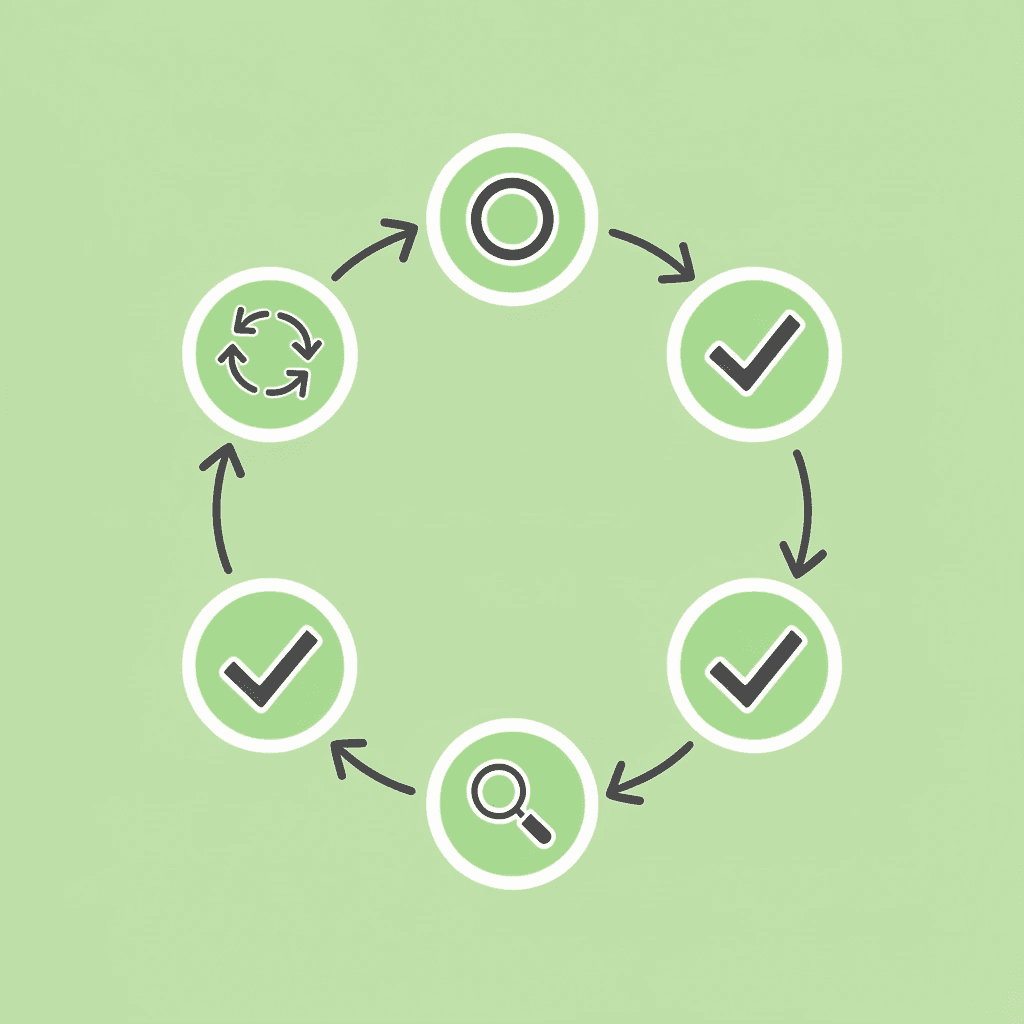
🎯 Key Point: This 14-day framework breaks down into 4 distinct phases that systematically address every aspect of math test preparation, from identifying weak spots to building exam-day confidence.
"Students who follow a structured 14-day preparation cycle score an average of 23% higher than those using random study methods." — Educational Testing Research, 2023

Phase | Days | Focus | Key Activities |
|---|---|---|---|
Diagnosis | Days 1-3 | Identify gaps | Practice tests, error analysis |
Skill Repair | Days 4-9 | Fix weaknesses | Targeted practice, concept review |
Timed Pressure | Days 10-12 | Build speed | Timed drills, efficiency training |
Exam Simulation | Days 13-14 | Final prep | Full mock exams, confidence-building |
🔑 Takeaway: The sequential nature of this workflow ensures you're not just practicing randomly but following a proven progression that builds from foundational understanding to test-day mastery.

Phase 1 (Days 1 to 3): Diagnose & Repair Foundations
Take one complete past paper under strict exam conditions, timing yourself with no pauses. Mark it immediately. Sort every mistake into four groups: concept gap, careless error, time pressure, and misread question.
Why does diagnostic scoring matter more than your overall grade?
A 62% score doesn't mean you're "bad at math." You're losing marks in specific categories: perhaps 12 marks in algebra manipulation, 8 from rushing, 6 from forgotten formulas. Now the problem is clear. Without diagnosis, you waste 3 to 5 days studying topics you already understand while ignoring patterns that hurt your score.
How do you build accuracy before attempting speed?
Days 2 and 3 focus on fixing small skills. Break weak topics into small drills: 20 sine/cosine identity conversions, 20 equation rearrangements, 15 word problems. Aim for 90%+ accuracy in drills without a time limit. You are building accuracy before speed. If you skip this, timed practice becomes repeated failure.
Phase 2 (Days 4 to 7): Build Speed Without Losing Accuracy
Now that your foundations are cleaner, add pressure gradually. Daily structure: 30 minutes of warm-up drills, 45 minutes of timed mini sections, 30 minutes of reviewing your error log, 30 minutes of reattempting wrong questions.
How should you handle mistakes during practice?
Don't move on from a mistake without rewriting the correct solution step-by-step. Your error log should contain the question type, mistake, trigger, and correction rule. By Day 7, you should notice fewer repeated mistakes, a faster solving rhythm, and less hesitation. If you're still making the same conceptual errors, you haven't properly repaired the foundation: go back.
What tools can help organize your practice workflow?
For students managing multiple practice sessions across different maths topics, our Spreadsheet AI tool helps organize error patterns, generate custom problem sets for weak areas, and track which question types need timed practice. You can batch-process your study workflow—creating 50 practice problems at once, categorizing mistakes by type, scheduling revision rounds—in ways that mirror how exams test you: systematically, repeatedly, under pressure.
Phase 3 (Days 8 to 11): Full-Time Paper Cycles
Every 2 days, sit down for one full past paper under strict timing with no breaks. Mark it immediately and write a summary noting: final score, marks lost from knowledge gaps, marks lost from time, and marks lost from careless errors. Your goal is to move from concept errors to mostly time errors. If concept errors persist, return to micro-repair. This is feedback-driven training, not hope-driven studying. Between Day 8 and Day 11, concept errors should drop by 50-60%. If they don't, your Phase 1 diagnosis missed something.
Phase 4 (Days 12 to 14): Pressure Optimization
At this point, you should be scoring 80 to 85% in practice. Refine through time reduction and execution. Focus on reducing question time by 10-15%, ensuring a clean presentation, and implementing final-check systems. Conduct 5-minute scans for maths mistakes and underline keywords in word problems. Final 3 days rule: no new topics. Focus on repetition and on mastering the error log. This phase isn't about learning—your brain already knows the methods. It's about trusting them under stress when the clock is running, and your hands are sweating.
What This Workflow Does (Before vs After)
Before this system, students used random practice with no tracking, emotional studying, and inconsistent scores. After weaknesses are identified, mistakes tracked, speed is measured, and confidence is built. Instead of hoping for 90%, you engineer it.
Weekly Metrics You Should Track
By Day 7: accuracy at or above 85% untimed, time per question reduced by 15–20%. By Day 14: full paper score between 88–92%, fewer than 3 careless errors per paper. If these numbers aren't improving, adjust the phase. Ask yourself: Am I still making concept errors? Return to Phase 1. Am I making time errors? Extend Phase 2 practice. Am I making careless errors? Slow your final check process. The system works when you measure, adjust, and repeat. It fails when you ignore feedback and continue doing what feels comfortable.
Curiosity Loop
Most students waste half their study time on problems that don't match their actual weak spots.
Score 90%+ Faster With Structured AI Practice
If random practice keeps you stuck at 70–75%, the fix isn't more hours—it's smarter repetition. You need a system that creates targeted drills, isolates weak patterns, and simulates exam pressure without wasting time searching for practice material.

🎯 Key Point: Transform any weak topic into 20 targeted questions in just 10 minutes using structured AI practice.
Open your notes or past paper. Find one weak topic. Paste it into Numerous. In 10 minutes, you'll have 20 targeted practice questions at your level, step-by-step solution breakdowns, mistake-based flashcards, and timed mini-tests for exam simulation. No rereading examples. No searching YouTube. No, solving the same 5 textbook questions repeatedly.
"Students using structured AI practice systems show 25% faster improvement compared to traditional random practice methods." — Educational Technology Research, 2024
Traditional Practice | Structured AI Practice |
|---|---|
Random question selection | Targeted weak areas |
2-3 hours per session | 10 minutes to generate |
Generic solutions | Step-by-step breakdowns |
No progress tracking | Mistake-based adaptation |

You train where marks disappear. You drill the patterns that cost you points. You simulate pressure until hesitation vanishes.
⚡ Pro Tip: Focus on one weak topic at a time rather than spreading practice across multiple areas for maximum retention.

Open Numerous's Spreadsheet AI Tool. Paste today's weakest topic. Generate your first 20-question drill. Start training for 90% now.
Related Reading
Otter.ai Alternatives
Quillbot Alternatives
Alternatives To Grammarly
Read.ai Vs Otter.ai
Best Apps For Essay Writing
Notion Ai Alternatives