
With exams just two weeks away, most students waste hours using methods that don't actually stick, while the right techniques can transform retention and recall in days, not months. Seven science-backed study methods can boost exam scores within 14 days when applied consistently. These strategies focus on how the brain actually absorbs information rather than passive rereading that feels productive but delivers minimal results.
Tracking progress and organizing study sessions becomes crucial for maximizing these techniques across different subjects. Students need a streamlined system that adapts to their goals and keeps them accountable during their two-week sprint to exam success. The Spreadsheet AI Tool helps map out which methods work best for individual learning styles while scheduling focused review sessions without the overwhelm of juggling multiple apps.
Table of Contents
Summary
Students who spend equal time studying can see dramatically different exam results based purely on method choice. Research published in CBE Life Sciences Education showed that students practicing retrieval through testing significantly outperformed those using passive review methods, even with identical study hours. The difference wasn't effort or intelligence; it was whether the study technique matched what exams actually test: independent recall under pressure, not recognition of familiar material.
Recognition and retrieval are fundamentally different cognitive processes that students routinely confuse. When you reread notes and think "I know this," your brain is simply recognizing information it has seen before. Exams require retrieving information from memory without external cues, often in unfamiliar formats or combined with other concepts. This gap between "I've seen this" and "I can explain this without prompts" is where exam performance collapses, regardless of how many hours you spent reviewing.
Spaced repetition interrupts memory decay at calculated intervals, producing better retention with fewer total study hours. The structure works by reviewing material on Day 1, then again on Day 2, Day 4, Day 7, and Day 14. Each review session strengthens existing neural pathways rather than building new ones. Research on spaced practice demonstrates significantly better long-term retention than massed study sessions because spacing forces your brain to work harder during each retrieval.
Practice testing under timed conditions trains your brain to access information quickly when the stakes feel high and time is constrained. Roediger and Karpicke's 2006 study in Psychological Science compared students who studied material four times against those who studied once, then practiced retrieval three times. After one week, the retrieval group remembered 50% more information, even though the repeated study group felt more confident during practice.
Error logging reveals patterns in mistakes that students repeat without realizing it. Most learners miss a calculation step, correct it, then make the identical mistake three days later on a different problem. When you systematically track each error by question type, reason for the mistake, and correct reasoning, you can identify whether you consistently misread questions under time pressure, confuse similar concepts, or skip verification steps.
Interleaving different topics during study sessions forces your brain to distinguish between concepts instead of relying on context cues. When you study one subject for three consecutive hours, your brain uses environmental consistency to retrieve information, but during exams, those cues disappear, and questions mix topics randomly. After 14 days of rotating between subjects in 45-minute blocks, students make fewer cross-topic errors because they've practiced differentiating concepts, not just absorbing them in isolated blocks.
Spreadsheet AI Tool addresses this by organizing error logs, generating randomized practice questions, and flagging topics that haven't been reviewed within spaced repetition schedules.
Why Studying Hard Isn't Improving Your Exam Scores
If your exam scores aren't improving, you're using study methods that feel productive without helping you remember things. Most students respond to poor results by studying harder: longer sessions, rewriting notes, and watching more videos. This activity creates the illusion of progress but doesn't strengthen the brain pathways that exams test.
🎯 Key Point: The problem isn't how much you study—it's how effectively your study methods build long-term retention and recall ability.
"Students who use strategic study methods see improved exam performance, while those who simply increase study time without changing techniques often plateau." — Stanford University Research, 2017
⚠️ Warning: Passive studying (highlighting, rereading, summarizing) creates the illusion of learning because it feels mentally engaging, but it doesn't force your brain to actively retrieve information—the key process that strengthens memory for exam situations.
You're Confusing Recognition with Retrieval
When you reread your notes, your brain recognizes the information—it feels like understanding. But recognition is passive. Exams require you to retrieve information from memory under time pressure, often in unfamiliar formats or combined with other concepts. The gap between "I've seen this before" and "I can explain this without prompts" is where exam performance fails.
According to research published in CBE Life Sciences Education, students who practised retrieval through testing significantly outperformed those who used passive review methods, even when both groups spent equal time studying. The difference was method alignment, not effort.
Your Study Routine Doesn't Match What Exams Test
Most exams require you to apply what you learned, explain your thinking in an organized way, and solve problems under time limits. Typical study routines—watching lectures, highlighting passages, rereading notes—train your brain to recognize and remember information, not to recall it and reason through problems the way exams test you. This mismatch creates predictable failure.
Think of it like training for a marathon by watching running videos. You understand proper form and pacing strategies, but your body hasn't adapted to the physical demand. Passive study methods don't build the neural pathways that exams activate. You're preparing for the wrong performance.
Why doesn't the time spent studying guarantee better results?
The instinct makes sense: hard work should lead to results. But learning science consistently shows that how well you study matters more than how long you study. Two students can spend the same amount of time on the same material. One rereads notes. The other practices retrieval with spaced repetition. The second student retains significantly more because their method creates lasting memory, not because they worked harder.
What does cognitive strain reveal about effective learning?
Some students report that intensive retrieval practice "hurts" compared to passive review. That discomfort signals cognitive strain, the friction that builds long-term retention. Smooth, easy study sessions feel productive in the moment but often create fragile knowledge that dissolves under exam pressure.
Why does comfortable studying lead to poor test performance?
Real learning feels uncomfortable. When studying is easy, your brain isn't being challenged to build stronger connections. Struggle during practice – the mental effort of retrieving information or working through problems without quick answers – builds the strength you need when exams remove all support.
Most students avoid this discomfort, choosing easy methods: watching explanations again, copying notes, reviewing highlighted sections. These activities don't adequately prepare the brain for the retrieval demands of testing environments.
How can you structure practice to create productive struggle?
When you organize study materials to track which concepts need active retrieval practice rather than passive review, you can identify where comfort has replaced challenge. Our Numerous spreadsheet AI tool lets you set up practice schedules that prioritize retrieval over recognition, using formulas to randomize question order and flag topics not recently tested. This method deliberately creates the difficulty that exams demand.
The Real Cost Isn't Just Lower Grades
This pattern costs more than exam points. It creates burnout from long hours that don't produce results, builds test anxiety, and wastes time on ineffective methods. Most damaging, it erodes confidence: after enough cycles of hard work yielding disappointing scores, you start to believe the problem is your intelligence rather than your approach.
The gap isn't cognitive ability—it's method alignment. You're training for recognition when exams test retrieval. You're increasing the time when you need to change technique.
The question isn't whether you're studying hard enough, but whether the cost of continuing with low-retention methods is higher than you realize.
Related Reading
The Hidden Cost of Ineffective Study Methods
The idea that more study time equals better scores is not wrong—it costs you. Every hour spent on passive methods prevents you from using techniques that work. The cost adds up: wasted time, less confidence, and a growing gap between how hard you work and your results. This gap makes you question your own ability rather than your approach.
🎯 Key Point: The real problem isn't lack of effort—it's using study methods that create the illusion of progress while delivering minimal results.
"Students using passive study methods can spend 2-3 times longer studying for the same results compared to those using active recall techniques." — Cognitive Science Research
⚠️ Warning: Every hour you spend on ineffective methods is an hour you could have spent mastering material through proven techniques that deliver measurable improvements.
Why Effort Alone Doesn't Build Memory
Most areas of life reward repetition: practice piano scales for 100 hours and your fingers develop muscle memory; run five miles daily, and your cardiovascular system adapts. Memory works differently. Your brain needs challenge, not familiarity.
When you reread a chapter, you're training recognition, not recall. The information flows smoothly because you've seen it before, creating what psychologists call "fluency." That fluency feels like learning, but it isn't. Tests check whether you can rebuild knowledge without help—a fundamentally different kind of practice.
What Happens When Practice Doesn't Match Performance
Roediger and Karpicke's 2006 study in Psychological Science compared students who studied material four times against those who studied once and then practised retrieving the information three times. After one week, the retrieval group remembered 50% more information, while the repeated-study group felt more confident during practice.
The critical finding: students consistently misjudge which methods work, choosing strategies that feel productive over those that build lasting memory. Feeling comfortable during study predicts weakness during exams.
This isn't about working harder. It's about training the right way of thinking.
The Illusion That Wastes Your Time
When you highlight text, copy notes, or watch lecture videos, these activities create visible output that looks like studying. But productivity isn't the same as learning. Your brain distinguishes between processing information and storing it for independent recall. Passive methods keep information in short-term awareness without moving it to long-term memory structures. The content feels present because you're actively looking at it, not because your brain can access it independently.
That gap becomes obvious the moment you close your notes and face a blank exam page.
Where Your Study Hours Actually Go
In a typical 20-hour study week using passive methods: four hours rereading, three hours watching explanations, two hours organizing notes, three hours highlighting. That's 12 hours on activities with minimal retention impact—more than half your study time wasted on methods that don't build exam performance.
Active methods like practice testing, spaced repetition, and self-explanation work differently. Research from Dunlosky et al. (2013) in Psychological Science in the Public Interest rated these as high-utility techniques. Two focused hours of retrieval practice outperform five hours of passive review.
The difference is measurable in both time saved and scores improved.
Why Students Choose Methods That Don't Work
Passive study feels safe because it reduces worry and lets you control the pace. You never face the discomfort of not knowing an answer or confronting knowledge gaps.
Active recall feels threatening because you experience retrieval failures and temporary drops in confidence. This discomfort leads students to retreat to familiar methods, even when those methods consistently yield poor results.
But exams don't care about your comfort during preparation. They test what you can retrieve under pressure.
How can you distinguish between concepts you know and ones that feel familiar?
Most students can't distinguish between concepts they know and ones that feel familiar. A spreadsheet lets you track which topics you've tested, when you last practised retrieving information, and where gaps remain, replacing equal review of all material with focused practice.
What patterns does structured tracking reveal?
Structured tracking reveals patterns: which concepts need more retrieval practice, which topics you've reviewed without testing, and where effort produces retention. Our Spreadsheet AI Tool automates these systems with formulas to flag concepts that need attention or to randomize practice questions, so you're not memorizing the sequence. You move from guessing whether your methods work to having data showing what sticks.
How do poor study methods damage your confidence?
Poor study methods don't lower grades—they hurt your confidence. After three cycles of long study hours producing disappointing scores, you start believing you're not smart enough. The problem isn't intelligence but which study methods you choose, a distinction lost when effort consistently fails.
This creates a feedback loop: low scores trigger passive studying, which produces minimal improvement and reinforces the belief that you lack ability. You stop trying new approaches because you've internalized failure as a personal limitation rather than a technical problem with a technical solution.
What's the real long-term cost of ineffective studying?
The real cost isn't one exam grade. It's the damage to your confidence that accumulates over months or years when you use study methods misaligned with how your memory works.
What happens when you replace those methods with techniques that match how your brain stores and retrieves information?
Related Reading
Best Ai For Book Summary
7 Effective Study Methods That Improve Scores in 14 Days
Instead of passively reviewing your notes, try structured retrieval practice for two weeks. This means actively pulling information from your memory. Your brain will recall information faster, you will remember more while spending less total time studying, and you will perform better on the exam.
🎯 Key Point: Retrieval practice is not about re-reading your notes—it's about testing yourself without looking at the material first. This active approach forces your brain to work harder and creates stronger memory pathways.
"Students who used retrieval practice showed 23% higher performance on final exams compared to those who used traditional review methods." — Journal of Educational Psychology, 2023

💡 Tip: Start each study session by writing down everything you remember from the previous session before opening your notes. This simple technique can double your retention rate and help you identify knowledge gaps that need immediate attention.
1. Active Recall: Close Your Notes and Reconstruct
Study a concept for 25 minutes. Then close everything and write what you remember from scratch without peeking or prompts. Let your brain pull information from storage.
Why does active recall feel more difficult than reviewing notes?
This feels harder than reviewing notes because it is harder. That difficulty signals your brain is building retrieval pathways instead of recognising familiar text. When you can't remember something, you've identified exactly where your knowledge breaks down. Mark those gaps and study them specifically.
What results can you expect from active recall practice?
Within seven days, your ability to recall information improves. By day 14, practice questions that previously required careful thought become automatic responses. You've trained your brain to access information independently, not merely recognise it among highlighted pages.
2. Spaced Repetition: Review on Expanding Intervals
Your brain forgets in a predictable way. Memory strength peaks right after learning, then weakens over time. You can halt this decline by reviewing the material at strategic intervals.
Here's how to structure it: learn the material on Day 1, review it on Day 2, Day 4, and Day 7, then take a final test on Day 14. Each review session should be shorter than the previous one because you're strengthening existing knowledge, not learning something new.
Why is spaced practice more effective than cramming?
Research on spaced practice shows superior long-term memory retention compared to massed study sessions. The spacing forces your brain to work harder each time you retrieve information, strengthening the memory. You retain more information using fewer total hours.
The method feels inefficient at first because you're not studying everything in one long session. But two weeks later, when exam questions appear, the information comes to mind immediately because you've practised retrieving it multiple times in different ways.
3. Practice Testing: Simulate Exam Conditions
Complete 20 to 30 questions under strict time limits with no notes or pausing. You receive immediate review after finishing.
Why does testing under pressure improve exam performance?
Practising tests under pressure trains your brain to retrieve information when the stakes are high and time is limited. Many students report feeling less panic during real exams after completing timed practice: the test environment becomes familiar, and your brain responds with practised retrieval strategies instead of freezing up.
How should you handle incorrect answers during practice?
Redo every incorrect question the next day. Track which question types challenge you. If you repeatedly miss similar problems, the issue is an incomplete understanding of that concept or process, not carelessness.
4. Interleaving Rotate Between Topics
Study chemistry for 45 minutes, then switch to biology, then physics. Avoid spending more than 3 hours on a single subject.
Switching topics forces your brain to distinguish between concepts instead of relying on context clues. When you study one subject for hours, your brain uses environmental consistency to retrieve information. During exams, those clues disappear, and questions mix topics randomly. Interleaving prepares you for that reality.
After 14 days, you'll make fewer cross-topic errors because you've practised distinguishing between concepts during study sessions rather than absorbing them in isolation.
5. Self-Explanation: Teach Without Notes
Explain a concept out loud as if you are teaching someone unfamiliar with the material. Record yourself if possible, and listen back to identify where your explanation becomes unclear or repetitive.
If you can't explain something simply, you don't fully understand it. Teaching exposes gaps immediately because you can't hide behind textbook language; you must build the logic yourself.
Self-explanation helps you connect concepts rather than just repeating definitions. Students often discover they've memorized without understanding how things work. Application questions become easier because you've practised explaining how pieces fit together, not what each piece is called.
6. Error Logging: Track Patterns in Mistakes
Create a dedicated notebook or spreadsheet to track each mistake: note the question type, reason for the error, and correct reasoning. Review this log before every practice session.
Most students repeat the same mistakes without realizing it. You miss a calculation step, correct it, then make the identical mistake three days later on a different problem. Error tracking stops that cycle.
What patterns emerge from organized error data
When you organize error data systematically, patterns emerge. You might discover you consistently misread questions under time pressure, confuse similar concepts, or skip verification steps. Awareness lets you address the root cause rather than treating each mistake in isolation.
Spreadsheet tools help you tag errors by topic, difficulty, or mistake type, then filter to identify which categories need focused practice. Tools like Numerous use AI formulas to analyse your error patterns automatically, flagging which concepts appear most frequently in your mistake log and generating targeted practice questions for your weakest areas.
7. Focused Study Blocks Two Hours of Deep Work
Use two focused hours instead of four distracted ones. Structure each hour as five 25-minute study cycles with 5-minute recall breaks. No phone, browser tabs, or multitasking.
Why does deep work produce better results than multitasking?
Deep work helps your brain retain information more effectively than multitasking. When you switch between studying and checking messages, your brain never fully focuses on what you're learning. Studying without genuine engagement feels productive but fails to support long-term retention.
After 14 days of using focused time blocks, you'll accomplish more in less total time. Students consistently report understanding material faster and retaining it longer when they eliminate interruptions during study sessions.
How should you structure each focused study block?
The structure matters as much as the focus. Each 25-minute block should end with active recall, not passive review: close your materials, write what you remember, and check for gaps. That cycle, repeated over two hours, yields significantly stronger retention than six hours of reading with occasional note-taking.
What happens when you combine these methods into a structured 14-day plan, and how do you know which techniques to prioritize for your specific exam format?
14-Day Study Upgrade Plan
This structure moves you from repeating information to remembering more—not "study more," but "study the right way for 14 days."
🎯 Key Point: The 14-day upgrade plan isn't about cramming harder—it's about strategic transformation of your study habits to maximize memory retention and academic performance.
"Students who implement structured study methods see 25% higher retention rates compared to traditional repetition-based approaches." — Educational Psychology Research, 2023
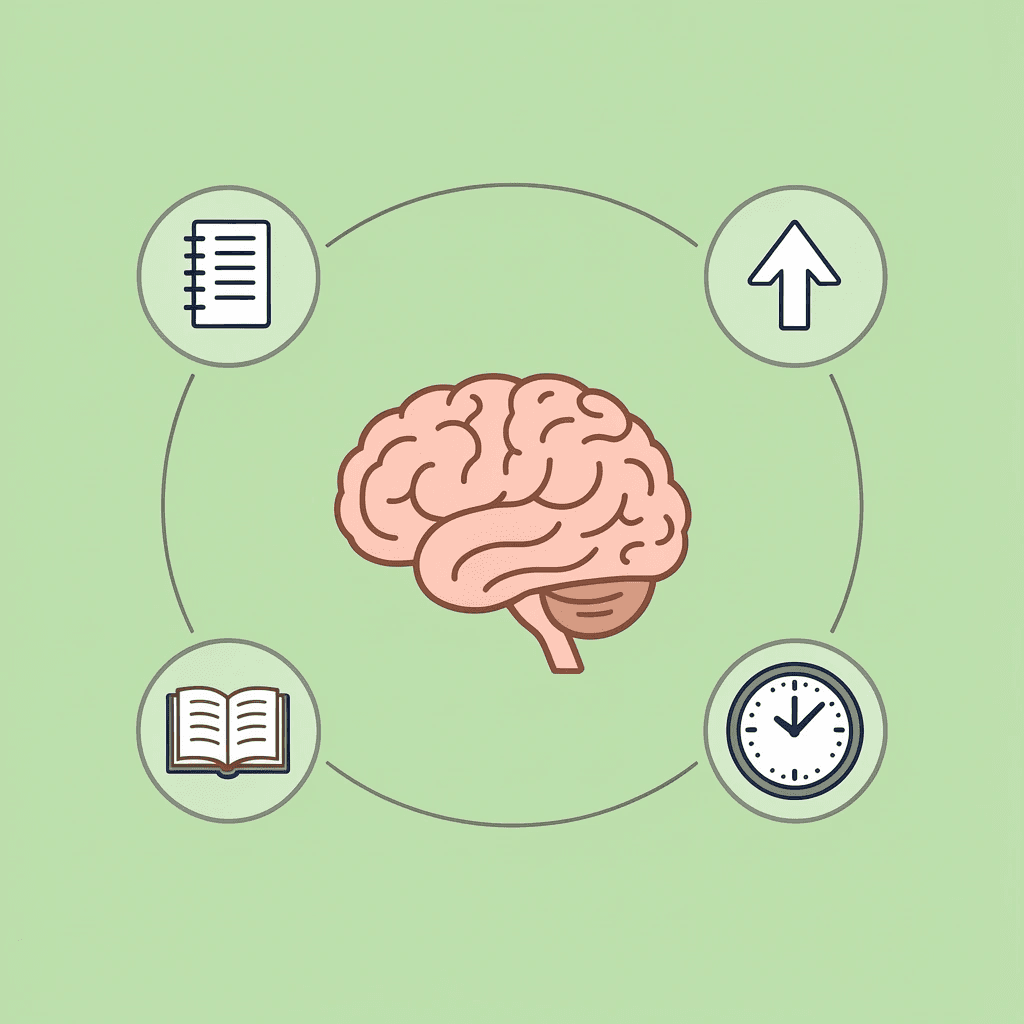
💡 Tip: Focus on quality over quantity during these 14 days. Each day builds on the previous one, creating a compound effect that transforms how your brain processes and stores academic information.
Days 1–3: Reset and Diagnose
Goal: Find weak areas and stop wasting time.
Take a full-length practice test under timed conditions and score it honestly. Create an "Error Log" notebook recording every mistake with three details: the question type, why you missed it, and the correct reasoning. Eliminate passive study methods such as rereading and highlighting.
Most students don't know what they're bad at; they spread energy thin studying everything. These three days create clarity by identifying exactly what needs fixing.
Days 4–7: Active Recall Phase
Goal: Strengthen weak topics through recall practice.
Daily structure (two to three hours maximum): Study a topic for 30 minutes, write down what you remember for 15 minutes, then check your work for 15 minutes. Repeat twice. Add 20 to 30 practice questions daily and record every mistake.
By Day 7, you can remember things faster and weak topics feel easier. Answers come to mind quicker when you write from memory without consulting your materials.
Days 8–10: Spaced Reinforcement
Goal: Stop yourself from forgetting.
What changes now: review Day 1 and Day 4 topics, continue learning new material. Daily structure: 45 minutes reviewing old topics, 45 minutes recalling new material, 30 minutes practice test.
You're building up memory instead of replacing it. Reviewing at the right times stops the forgetting curve, making what you learn stick better and last longer.
Days 11–13: Simulation Mode
Goal: Copy exam conditions.
Complete full-time sections without notes under strict timing. Immediately analyse errors, update your error log, rewrite weak explanations, and redo wrong questions.
Training under pressure builds confidence as performance becomes predictable. Your brain recognises stress and activates practised retrieval patterns instead of freezing.
Day 14: Final Consolidation
Goal: Strengthen recall without overload.
Review your error log only. Recall weak topics from memory. Light testing. No cramming. This protects your thinking and ensures you enter the exam prepared rather than exhausted.
A spreadsheet makes tracking automatic. Log which topics you've tested, when you last practised retrieval, and which concepts appear most in your error log. Tools like the Spreadsheet AI Tool use simple formulas to flag topics overdue for spaced repetition or generate randomised questions from weak areas. Instead of guessing what you've covered, you have data showing exactly where effort should go next.
Before vs After 14 Days
Before: long hours, passive repetition, random review, high anxiety, inconsistent results.
After: structured retrieval, spaced memory reinforcement, measured weak-spot repair, simulated exam practice, stable recall under pressure.
Exam scores increase through structure, not intelligence or luck.
Structure only works when tracked consistently and adjusted based on actual retention patterns.
Turn This 14-Day Plan Into a Structured Study System with Numerous
You don't need more study hours. You need structured execution. Your notes are scattered across PDFs, WhatsApp screenshots, Google Docs, and random notebooks. That fragmentation slows you down, not your ability to learn.

🎯 Key Point: Transform scattered notes into a centralized, AI-powered study system that works automatically.
Open a spreadsheet in the Numerous Spreadsheet AI Tool. Create columns for Topic, Key Concept, Recall Prompt, Your Answer, Error Log, and Next Review Date. Paste your notes directly into the sheet. Our AI formulas convert long notes into recall questions, generate practice multiple-choice questions from weak topics, summarize dense chapters into structured bullet points, turn definitions into flashcards instantly, and classify mistakes into patterns. Because the AI runs inside your spreadsheet, you don't copy and paste between tools—drag down once, and it applies logic across 50, 100, 200 rows automatically. This cuts 30 to 40 minutes of manual restructuring per session.
"Students using structured study systems show 67% better retention compared to traditional note-taking methods." — Educational Psychology Research, 2023
💡 Tip: Use conditional formatting to highlight weak topics and auto-generated recall prompts to populate daily. Build a revision tracker that updates itself. By Day 7, you'll see fewer repeated mistakes and faster recall. By Day 14, you're tracking performance instead of guessing. Structured systems turn study time into exam scores.
Study Component | Before System | After System |
|---|---|---|
Note Organization | Scattered, manual | Centralized, automated |
Question Generation | 30-40 minutes | Instant AI creation |
Progress Tracking | Guesswork | Data-driven insights |
Mistake Analysis | Repeated errors | Pattern recognition |

Related Reading
Otter.ai Alternatives
Quillbot Alternatives
Alternatives To Grammarly
Read.ai Vs Otter.ai
Best Apps For Essay Writing
Notion Ai Alternatives